The National Mythology Exam

Normally I wouldn't put family news in this blog, but this relevant item appeared in my daughters' school newsletter:

2010 National Mythology Examination

Earlier this year, over 100 students in Years 4–10 participated in the 20th annual National Mythology Examination, along with over 10,000 others from the USA, Canada and Australia. This exam tested knowledge about Greek and Roman classical myths as well as Virgil’s Aeneid. Their outstanding results have been worth the wait...

What a brilliant idea! I'd never heard of it before. The National Mythology Exam is the brainchild of the American Classical League, whose motto is Excellence Through Classics. Their stated goal is to promote classics in elementary and middle schools, and introductory classics courses.

The school's results were indeed outstanding, but I won't repeat it all except for this bit at the end:
The talented students in Years 4–7 deserve special congratulations, because they participated quite voluntarily in the examination, giving up their own free time to study for it.

Most commendably, seven of these students gained a perfect score: Catriona Corby ...

I'd give the names of the other six with perfect scores except I don't have parent permission. I had no idea Catriona was doing this until she brought home the material to read. She did all the study on her own. So now you know my excuse for writing the post: I'm being a proud daddy.

And seriously, this means there are 10,000 kids out there who've read some classics, who otherwise might never have seen them. Top marks to the Classical League.


Mouse Cuisine

A few comments in the previous post raised the question of how anyone could know what mouse tastes like. I'm glad you asked...

Mouse and rat has been a staple of cities under prolonged siege since time immemorial.

Back in the days of wooden ships and iron men, the midshipmen of His Majesty's Royal Navy ate the rats on board after the meat ran out. They called them millers. Patrick O'Brian on multiple occasions takes great delight in pointing this out in his sea stories.

The Romans ate dormice. There's an old joke of ancient historians called the dormouse test, which I think was devised by Mary Beard:

The best way to judge a modern recreation of ancient Rome - in film or fiction - is to apply the simple "dormouse test". How long is it before the characters adopt an uncomfortably horizontal position in front of tables, usually festooned with grapes, and one says to another: "Can I pass you a dormouse?"

The basic rule of thumb is this: the longer you have to wait before this tasty little morsel appears on the recreated banquet, the more subtle the reconstruction is likely to be.

There was a book written long ago called Unmentionable Cuisine, by Calvin Schwabe, which was basically an attempt to gross out the reader. (Not that I could ever be accused of doing that...) . Unmentionable Cuisine includes a recipe for Grilled Rats Bordeaux Style, and claims that to this day much of the meat eaten in Ghana is mouse and rat.

And if you think it couldn't happen today...the Canadian biologist Farley Mowat gives this recipe for mouse in his book Never Cry Wolf:

Souris à la crème

Skin, gut and wash some fat mice without removing their heads. Cover them in a pot with ethyl alcohol and marinate 2 hours. Cut a piece of salt pork or sowbelly into small dice and cook it slowly to extract the fat. Drain the mice, dredge them thoroughly in a mixture of flour, pepper, and salt, and fry slowly in the rendered fat for about 5 minutes. Add a cup of alcohol and 6 to 8 cloves, cover and simmer for 15 minutes. Prepare a cream sauce, transfer the sautéed mice to it, and warm them in it for about 10 minutes before serving.


This post was written while listening to Don't Fall In Love, by The Ferrets.


Hemlock

Hemlock is a neurotoxin which paralyses the nervous system. Hemlock is the name of the plant from which the poison comes, the active component is coniine, an alkaloid. It acts from the extremities and moves up the body until it reaches the torso, at which point breathing is arrested. The Greeks wrongly believed that death was due to the poison stopping the heart. In fact the victim asphyxiates.

Hemlock was the poison of choice for offing citizens of Athens, so long as their crime wasn't bad enough to merit something nastier, such as stoning. Hemlock was very much the easy option, and of course its most famous victim was Socrates. There are actually a number of plants in the hemlock family. The one used to make the poison which executed Socrates was Conium maculatum, called simply Poison Hemlock. There's also Water Hemlock, which if anything is even more toxic, and a tree called hemlock.

Two things I better say right at the start, just in case some idiot eats hemlock and survives to sue me: don't even think about touching the stuff; also, I'm not a doctor.

Every part of the plant is toxic, but the roots and berries particularly so.

Believe it or not, some Greek doctors prescribed hemlock as a medicine. In fact hemlock was used as a herbal medicine up until relatively recent times. Clearly doctors' professional practice insurance isn't what it used to be. For what did they prescribe it? Arthritis, and any disease that involved involuntary movement. The paralytic effect stopped the shaking.

The danger is that the difference between a medicinal and a fatal dose is very, very small. I've read texts which suggest 1 leaf is medicinal and 6 leaves is fatal. But of course your mileage will vary depending on the individual plant, which parts were used, and the size and sensitivity of the patient-cum-victim.

There have been well documented cases of accidental poisoning in the last hundred or so years, some of them very tragic. I've read of one case where someone sucked a tuber of water hemlock, having mistaken it for a different, edible plant. Poison hemlock resembles parsley closely enough that someone could make a mistake. Children playing in the woods are particularly vulnerable, both because they're more likely to make the mistake and because with their smaller bodies the poison takes effect quicker.

The effect of hemlock seems to vary widely. Some cases record convulsions, others report the victim dying quietly over hours and remaining conscious and rational to the end, which was the experience of Socrates.

There's no cure, but if you do accidentally ingest hemlock and you realize it in time, then all is not lost. It takes quite a while to die, and if you can get to a hospital in time -- don't run, in fact don't move at all if you can help it -- then they'll put you on an artificial breathing and heart pump machine until the paralysis has worn off, after which you should be okay, if somewhat terrified.

Here's a picture of Poison Hemlock:


This gorgeous image belongs to J. Alex Halderman, an amateur photographer of very great skill.

Hemlock is present as a weed in Australia. It was deliberately introduced by some moron who thought there weren't enough poisonous things in this country, so he added one more.

Here's the famous description of the death of Socrates. It was written by Plato in his book Phaedo. I've taken it from the online Perseus edition.
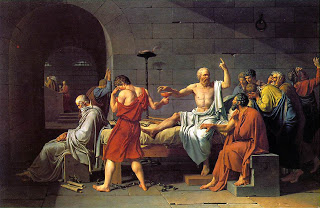

Thereupon Crito nodded to the boy who was standing near. The boy went out and stayed a long time, then came back with the man who was to administer the poison, which he brought with him in a cup ready for use. And when Socrates saw him, he said: “Well, my good man, you know about these things; what must I do?” “Nothing,” he replied, “except drink the poison and walk about till your legs feel heavy; then lie down, and the poison will take effect of itself.”
...
He walked about and, when he said his legs were heavy, lay down on his back, for such was the advice of the attendant. The man who had administered the poison laid his hands on him and after a while examined his feet and legs, then pinched his foot hard and asked if he felt it. He said “No”; then after that, his thighs; and passing upwards in this way he showed us that he was growing cold and rigid. And again he touched him and said that when it reached his heart, he would be gone. The chill had now reached the region about the groin, and uncovering his face, which had been covered, he said—and these were his last words—“Crito, we owe a cock to Aesculapius. Pay it and do not neglect it.” “That,” said Crito, “shall be done; but see if you have anything else to say.” To this question he made no reply, but after a little while he moved; the attendant uncovered him; his eyes were fixed. And Crito when he saw it, closed his mouth and eyes.


Some people have actually used this passage to suggest Socrates was not killed by hemlock. The major objection is that Socrates' legs are described as cold and rigid. It's got to be wrong. Hemlock produces a flaccid paralysis.

However in the past 100 years there have been some cases of accidental poisoning which precisely matched the symptoms Plato describes, except for the flaccid muscles. The obvious answer is Plato is being misread here (easy to do with one word after 2,500 years) or else it's a copy error.

Hemlock is said to have a fetid taste, somewhat akin to a mouse. It can't be all that strong though, considering the number of people who've eaten it accidentally. One man even ate it in a sandwich. Nevertheless any mouse odor is easily masked by mixing it with Ancient Greek wine, which often had fenugreek added. I personally have tasted a similar Roman wine called Turriculae. Believe me, Turriculae could mask almost anything.

I suspect the execution potion that killed Socrates was hemlock mixed with strong wine.

Another possibility, clearly not used with Socrates since he remained rational, would be to add a sedative. Greek medicine was very primitive, but we know they were expert at making opium. It makes sense to mix poppy juice with the hemlock; not everyone would be as calm about dying as Socrates was, and it's easy to imagine a distraught prisoner causing considerable trouble. After a good slug of poppy juice the prisoner wouldn't care if his legs fell off, let alone lost feeling. This is the ancient world's equivalent of death by lethal injection, and I'm not sure it isn't just as effective and perhaps even more merciful.

Lolita

Could Lolita be published today if someone submitted it?

The question came up in a conversation between me and the perspicacious Judith, who comments on this blog from time to time. Judith used to be an intern at FinePrint, where she read my second book and wrote an amazingly well thought out review. Now she reads queries as a literary assistant at another agency (and I'm embarrassed to admit I don't know which one). She has her own blog at I Eat Books Like You For Breakfast. If you're interested in the humble dynamic life of a literary assistant, then Judith's blog would be a good one to follow.

Judith recently handed in her dissertation, which happens to be on a book you may have heard of, called Lolita. She has a clear view on it. Judith commented in a post on her own blog that:
...Lolita...is undoubtedly the best novel written in the English language. Ok, so maybe not the best, but it's fourth best: Modern Library 100 Best Novels in the 20th Century.
Which caused me to question whether Lolita could be published today.

Judith's view: Could Lolita be published today? I think yes. Especially if Humbert's charming, witty voice comes through in the query. I bet tons of agents would request it and ask for a 2-week exclusive in a heartbeat. I don't think the subject matter would get in the way of agents wanting to represent it, since the voice is just so irresistible. What do you think, ya?


What I think: Lolita is brilliantly written, obviously, but I'm trying to imagine the agent's call to the editor. I imagine it would go something like this:

Agent: I have a great novel. Utterly brilliant voice. You'll love it!

Editor: What's it about?

Agent: It's a sympathetic look at pedophilia.

Editor: Do you have anything else?


So, what do you think?

The Old Bailey

The Old Bailey has been the central criminal court of England for hundreds of years. You can imagine how many thousands of criminal cases they've heard.

The records of the Old Bailey, from 1674 up to 1913, are now online, at OldBaileyOnline.org. I've already wasted hours reading them, and I bet you will too. The web site is beautiful, has an outstanding search system, and the most fascinating records. It's just wow.

The first thing I did, of course, was go name surfing. In only a few minutes I found this record. Let me introduce you to my ancestor, in the criminal trial of...

WILLIAM CORBY, Theft > pocketpicking, 6th July 1835

WILLIAM CORBY was indicted for stealing, on the 3rd of July, 1 handkerchief, value 2s. 6d. the goods of Charles Frederick Edgar, from his person.

CHARLES FREDRICK EDGAR . On the 3rd of July I was in Clerkenwell—I had this handkerchief in my pocket, and lost it—I do not know who took it.

THOMAS HEADWORTH . I live in St. John-street. About three o'clock, I saw the prosecutor walking in that street, and the prisoner was close behind him, touching his pocket—I went to the door, and saw his hand in the pocket—he drew the handkerchief out, and passed it form his right hand to his left—I immediately ran and laid hold of him—he threw it down—I told the gentleman, who took it up.

Prisoner. Q. Did you not say a man in a velvet coat threw the handkerchief down, and it went on my breast.

A. I did not.

GUILTY . Aged 20.— Transported for Seven Years.

Or at least, my relatives who've researched the family history tell me this is the fellow from whom we're descended.

It's a good thing my ancestor took to a life of crime. Based on his defense, he would never have made it as a lawyer.

Why didn't Corby argue that he was walking behind Edgar, saw the handkerchief fall, and picked it up to return it? He still needs to impugn Headworth as a witness, but he can argue the angle of sight, and Headworth's natural suspicion, led him to misinterpret an innocent event. The agreed fact that Edgar felt nothing helps the claim of an accidental fall.

Yes, yes, I know...my illustrious forefather is obviously a petty thief, but seriously, almost any defense is better than asking the prosecution's only witness to change his mind with a leading question.


The earliest record of a criminal Corby is another William Corby in 1770 for highway robbery, violent theft, receiving, and grand larceny. Needless to say he dangled for that lot.

I also discovered that there was a police officer called George Corby, variously described as a beadle, a constable, and a street-keeper who, if the number of times he appears is any indicator, touched an amazing number of collars. GC (same initials!) appears to have been more Lestrade than Holmes, but nevertheless the temptation to write some short stories is almost overwhelming.