Salaminia was the Air Force One of the ancient world.
 Salaminia was a trireme in the Athenian Navy, easily the most powerful fleet in the world throughout the golden age of Greece. There were about 300 ships in the fleet at its peek, but Salaminia and her sister ship Paralos were special. They were fitted with only the best equipment, crewed only by Athenian citizens who volunteered for the job, and used for delicate diplomatic missions, when getting the ambassador where he needed to go quickly was of the greatest importance.
Each year too, Salaminia and Paralos carried gifts to the Sanctuary of Apollo on the isle of Delos, one of the holiest places in all Hellas. Any sacred duties requiring a ship, Salaminia and Paralos got the job.
 Triremes carried almost as many crew as a modern destroyer - about two thirds the modern complement - though with quite different job allocations since not many modern warships need to be rowed.
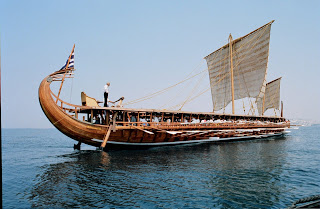
Triremes were rigged with square sails, but you only read of the sails being used to boost the efforts of the rowers, and sails were never used in battle, when manouverability was all. I'll do a post on naval tactics some other time; how they fought the ships is fascinating.
The trireme needed about 170 men to row it, sitting in (surprise!) three rows. The top row of oarsmen, called the thranites, could get air and light. The zygios sat cramped on benches below the heads of the men above them, and squashed at the bottom, the thalamios had to pull oars jammed against the hull and with two layers of stinking men above them. Even in ancient times there were jokes about the men at the bottom being farted on, or worse.
 Contrary to the picture most people have, they were free men on every trireme, meaning hired hands and mercenaries as well as citizens, but never slaves. More than that, on Salaminia and Paralos they were exclusively citizens of Athens, since those two had sacred religious duties. The rowers were presumably poor – surely the only reason a man would volunteer for this duty – but they had every right a citizen had.
Slaves were not used for a very good reason. Think about what would happen if slaves were in a position to take control of the most powerful fleet in the world.
In addition to the 170 engines, there was a singer and an aulos player to keep the time. There was not a drummer, again contrary to popular image. The aulos was a wind instrument like a recorder but with two pipes in a V.
 The captain was called the Trierarch, and he was useless. The Trierarch was generally the wealthy Athenian who'd paid for the ship to be built and maintained. With a total lack of taxation, the way things got paid for was sort of interesting, but I'll save that for another post. The short description is, the guy who donated the ship to the state got to call himself captain.
The man who was really in charge was the helmsman. There was also a foredeck officer called the proreus in charge of looking where they were going, because the helmsman at the back of a 40m (130ft) ship couldn't necessarily see anything close. A rowing chief on each side kept the rowers in check and, I suspect, headed off fights.
 The Greeks thought of their ships as female, like we do. Salaminia means the Girl From Salamis. I've always assumed the ship was named in honor of Athen's greatest victory at sea, over the Persians in the straits of Salamis, but I've never seen it stated anywhere - it's merely my assumption. If someone could tell me the correct etymology I'd appreciate it.
There is one single trireme left in the world, though sadly no longer sailing the seas. Olympias is a fully commissioned ship in the modern Greek Navy. The pictures in this post are all of her, downloaded from the Greek Navy's website.
Salaminia was a trireme in the Athenian Navy, easily the most powerful fleet in the world throughout the golden age of Greece. There were about 300 ships in the fleet at its peek, but Salaminia and her sister ship Paralos were special. They were fitted with only the best equipment, crewed only by Athenian citizens who volunteered for the job, and used for delicate diplomatic missions, when getting the ambassador where he needed to go quickly was of the greatest importance.Each year too, Salaminia and Paralos carried gifts to the Sanctuary of Apollo on the isle of Delos, one of the holiest places in all Hellas. Any sacred duties requiring a ship, Salaminia and Paralos got the job.
Triremes carried almost as many crew as a modern destroyer - about two thirds the modern complement - though with quite different job allocations since not many modern warships need to be rowed.Triremes were rigged with square sails, but you only read of the sails being used to boost the efforts of the rowers, and sails were never used in battle, when manouverability was all. I'll do a post on naval tactics some other time; how they fought the ships is fascinating.
The trireme needed about 170 men to row it, sitting in (surprise!) three rows. The top row of oarsmen, called the thranites, could get air and light. The zygios sat cramped on benches below the heads of the men above them, and squashed at the bottom, the thalamios had to pull oars jammed against the hull and with two layers of stinking men above them. Even in ancient times there were jokes about the men at the bottom being farted on, or worse.
Contrary to the picture most people have, they were free men on every trireme, meaning hired hands and mercenaries as well as citizens, but never slaves. More than that, on Salaminia and Paralos they were exclusively citizens of Athens, since those two had sacred religious duties. The rowers were presumably poor – surely the only reason a man would volunteer for this duty – but they had every right a citizen had.Slaves were not used for a very good reason. Think about what would happen if slaves were in a position to take control of the most powerful fleet in the world.
In addition to the 170 engines, there was a singer and an aulos player to keep the time. There was not a drummer, again contrary to popular image. The aulos was a wind instrument like a recorder but with two pipes in a V.
The captain was called the Trierarch, and he was useless. The Trierarch was generally the wealthy Athenian who'd paid for the ship to be built and maintained. With a total lack of taxation, the way things got paid for was sort of interesting, but I'll save that for another post. The short description is, the guy who donated the ship to the state got to call himself captain.The man who was really in charge was the helmsman. There was also a foredeck officer called the proreus in charge of looking where they were going, because the helmsman at the back of a 40m (130ft) ship couldn't necessarily see anything close. A rowing chief on each side kept the rowers in check and, I suspect, headed off fights.
The Greeks thought of their ships as female, like we do. Salaminia means the Girl From Salamis. I've always assumed the ship was named in honor of Athen's greatest victory at sea, over the Persians in the straits of Salamis, but I've never seen it stated anywhere - it's merely my assumption. If someone could tell me the correct etymology I'd appreciate it.There is one single trireme left in the world, though sadly no longer sailing the seas. Olympias is a fully commissioned ship in the modern Greek Navy. The pictures in this post are all of her, downloaded from the Greek Navy's website.
