Ephesus, and why the city was abandoned

Ephesus was one of the major port cities on the coast of the Aegean Sea in the ancient world. Most people these days know of the city from the Bible. Think Paul's Epistles to the Ephesians. Those with a classical bent will know of Ephesus as home to one of the Seven Wonders of the Ancient World: the Temple of Artemis, which unfortunately you can't see here because it was leveled to the ground. But most importantly for people back then, Ephesus was a major port where ships of any size could dock. Ephesus made all its money from trade.

I'll be writing more about Ephesus from time to time in this blog because Nicolaos and Diotima visit there in their second book. They've walked the roads and visited the places you see in this picture.

Ephesus
Sadly, Ephesus died, as you can tell, and was abandoned. The reason was silt build up in the harbor, which eventually reached the point where no ship could reach the city. Without ships, trade died. Without trade, the city died.

The semi-circular white blob in the top middle is a huge amphitheatre with astounding acoustics. I know, I've walked these ruins. The almost-horizontal white line running from the amphitheatre is the road to where the docks used to be. The left end of the road, which seems to stop abruptly, is where the docks would be if silt had not destroyed the harbor. As you can see, it's now land.

Here's how much of a silt problem Ephesus had. I've put a circle around the ancient city.

Ephesus to the coast
Remember, this was a major port in the Greek world. Anyone who thinks a changing planet is a modern problem should take a close look at this picture.
Happy Easter! or Happy Eostre! or Happy Great Dionysia!

Happy Easter to everyone!

Our Easter is derived directly from a Germanic pagan fertility Goddess called Eostre, if you speak Old English, or Ostara, if you speak Old High German. In either case, if you ever wondered what bunnies and eggs had to do with Jesus, now you know: nothing at all. They are both very obvious fertility symbols associated with the Goddess. Interestingly, Eostre is mentioned in writing in only one place, the work of the Venerable Bede, a mediaeval monk and early self-publisher.

The Greek celebration of the same time was the Great Dionysia, a hugely important festival in honor of Dionysos God of Wine and the Harvest, held over 5 days in the middle of the month of Elaphebolion. (That was the city version. An older rural version was held in the month of Poseidon.)

Everyone was welcome to celebrate, citizens, metics (resident aliens) and visitors from other cities. A statue of Dionysos was carried to the Theatre of Dionysos, which rests against the southern side of the Acropolis. People walked around carrying phalloi carved from wood, and one very large phallus was pulled along on a cart.

Maidens walked about carrying woven baskets. Some carried long loaves of bread. Others carried water jugs or wine jugs, and would pour drinks for anyone.

A huge number of oxen were sacrificed in the theatre. There was more to this than merely the religious aspect; this was a chance for even the poorest people to get some free red meat. It was a massive feast. There were several processions and a komos, a parade-cum-drunken-revel.

The orphans of men who had been killed in battle were paraded to honor their fathers (the state paid for these orphans until they reached majority). People who had done good deeds during the year were held up for priase.

The Great Dionysia affected civilization to this very day, because it was the festival in which the tragedies and comedies were shown on stage. Beginning some time in the 500s BC, the Great Dionysia turned from a purely religious celebration to include an arts festival. All the great ancient Greek plays you may have read, everything from Sophocles, Euripides, Aeschylus and Aristophanes, those plays first appeared on stage at a Great Dionysia. People travelled from all over Greece to come and see what was on that year.

The Spring Equinox was also the time when the Goddess Persephone rose from the underworld to renew the earth. The story goes that she was kidnapped from the surface by Hades, God of the Underworld and Lord of the Dead, who wanted to marry her. He had the permission of Zeus to do this, but unfortunately neither of the guys thought to mention this plan to either the bride or her mother.

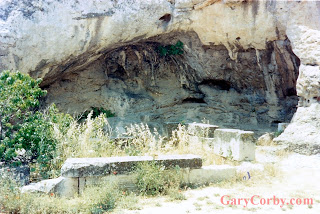
The kidnap of Persephone occurred in Eleusis, just down the road from Athens. Legend has it that this is the cave from which Hades emerged to grab her:

Cave from which Hades emerged to kidnap Persephone
If you're wondering how Hades managed to emerge from the underworld via a cave with no visible depth, so am I. But I guess when you're a God you can do these things. This is definitely the spot legend attributes. There used to be a small temple to the event, the ruins of which you can spot in the foreground.

Mom was the Goddess Demeter, in charge of making things grow, and she was more than a little annoyed to discover her daughter had involuntarily eloped. She stopped the growth of all things until she got her daughter back. They eventually hammered out a deal whereby Persephone spent half the year with her husband (autumn & winter), and the other half with her Mom (spring & summer), which goes to show even the Lord of the Dead may tremble when his Mother-In-Law throws a hissy fit.

I hope the Easter Bunny brings you something nice!

House plans

Houses in Classical Athens ran to a general plan. When the house slave let you in, you would see public rooms to your left or right. That was the andron, because it was for men only. You would see a courtyard directly before you, which was the real living room for the family. Greek life was outdoors, even at home. The courtyard would not have been square, it was more a matter of taking whatever space you could get. The one constant you would find in every courtyard was the altar to Zeus Herkeios. The head of the family prays and offers a small sacrifice here every day, an act considered so important that as part of the inauguation oath for any public office, a man had to swear he had an altar and sacrificed at it every day.

The women's quarters are one wing running beside the courtyard. The lady of the house probably sleeps in the upper story. The men's quarters are on the other side, so that the whole building is in the shape of a U with the base of the U facing the street and the courtyard in the middle. The kitchen is behind the courtyard, which is also where the slaves sleep. Somewhere out the back too, probably as far away as possible, is a hole in the ground which is the toilet. Odds are the man of the house has a private office, however small, on the second story, probably toward the front. Children probably slept in porticoes toward the back of the courtyard.

Women probably ruled the household with an iron fist. They might not have had any say in how the city was run, but by the Gods, when you walked into their home you were on their turf. They had total control of the house slaves. Everyone had slaves. A man was considered poor if he could only afford two to help his wife.

House burglars in Athens were not called burglars. They were called wall piercers, because the quality of building was so low, it was easier to punch a hole in the wall than break through the door. Thieves would punch a hole, then reach in with an arm to feel around and take stuff. Of course, it wasn't like modern houses where a burglar had a chance of finding an empty house. There were always at least a couple of slaves at home. Door locks could be very simple: a bar across the door. The locking mechanism is the slave on the inside who lifts the bar and opens the door for you when you knock and shout.

Making a shambles of town planning

You might have an image of Classical Athens as a pristine place, where men in pure white tunics walked serenely between marble buildings.

Nope.

The Agora was beginning to get marble public buildings at the time of my first book, but Athens was fundamentally mud daub walls with wooden frames and straw or wooden roofs. Many houses were double story - space was short - but three stories was beyond them. To create more space people built their second stories leaning out over the first, just like the famous Shambles in York, England. There were city edicts against building over the street line, which were universally ignored. Walking down a narrow lane in Athens would have been a bit like going down a tunnel. The light would only have appeared in the center of the lane, but you wouldn't walk down the middle because if you did, you were likely as not to get a bucketfull of slops dumped on your head when a slave poured a bucket out a second story window.

The roads were dirt, or more accurately, mud, because the road was the place to toss the household slops and waste. No public garbage collection, of course. Streets sloped inwards to get rainwater and mess away from the walls, same as the mediaeval arrangement. If the street was on a slope then it acted like an open sewer and the muck flowed away. If the street didn't slope, then the muck stayed where it was. A house-proud wife probably had her slaves sweep mess along to outside the neighbors.