The dog of Xanthippus

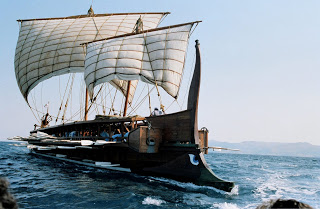
Xanthippus, the father of Pericles, was a war hero from the time of the invasion of the Persians. In the early stages of the conflict he commanded a trireme.

Like any wealthy landholder, Xanthippus owned a hunting dog. We don't know the name of his dog, but we do know they were inseperable. They went to war together, even to sea battles.
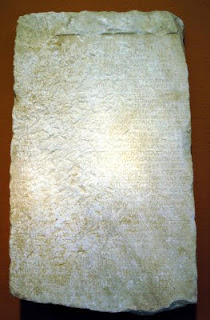
After the Persians broke through at Thermopylae it was clear Athens couldn't be saved. Themistocles, who more or less commanded the Greek forces, ordered the evacuation of the city. Amazingly, his proclamation still exists, inscribed in a stone tablet. Here's a picture from Wikimedia Commons. The authenticity of the tablet is considered controversial by some, but the odds are fair you are looking at the real thing.

Even with the best preparation, the evacuation of a major city could have been nothing but a shambles. Crowds of people – the whole city, tens of thousands – packed the ports desperate to get away before the Persians enslaved the women and children and killed the men.

The Athenians used their whole fleet, which was the largest in the world, plus anything that would float. Hundreds of boats rowed from the port of Piraeus to the island of Salamis where they had refuge, every trip dangerously overloaded. It was like an ancient version of Dunkirk but with civilians thrown in. Herodotus says it was amazing how few boats capsized.

This was 19 years before the time of my first novel. Nicolaos is 1 year old; Pericles is a boy. They would both have been taken to the relative safety of Salamis. But there weren't enough boats to save everyone. They got away all the able-bodied men, and the women and children who were the future of the city. Then they had to make some hard decisions. Old men, old women, the badly injured and the sick, had to stay behind. There was no room or time.

Xanthippus commanded the last boat out. Probably the Persians were already in the city. The dog of Xanthippus was occupying very little room, but it was room where another man could stand. Xanthippus had to choose between his dog, and saving the life of one more Athenian. He released the dog onto shore and ordered him to run away to the hills, hoping he'd survive. The men began to row. The boat would have been so full the sea lapped at the gunwales. The people left behind would have been wailing and screaming for them to return.

Xanthippus' dog watched his master depart. Then he leaped into the sea, and swam. He caught up the boat and stayed with it, swimming alongside. The people onboard saw what he was doing and shouted encouragement. There's no way a dog should have been able to keep pace with a trireme, but he did. Presumably the load on the trireme was such it could move only very slowly. To swim the distance was impossible, but the dog refused to give up.

The dog of Xanthippus swam all the way from Piraeus to Salamis.

When they got there the dog staggered up onto the beach and collapsed onto the sand, and there, with Xanthippus, he died of exhaustion.

Xanthippus was devastated. He built a tomb for his dog at the place where he died, and ever after, that point on the headland was called Dog's Tomb.

A few days later, in a do-or-die effort, the Greeks crushed the Persian navy in the straits of Salamis.

Coach or trainer?

A question for those of us who speak fluent American: do you say coach or trainer to refer to someone who is directing your training for a sport? I think trainers usually means shoes.

He wore out his trainers could mean one of two things.

He sat on the coach has its ambiguities too.

He sat with his coach on the coach clutching his trainers
doesn't bear thinking about.

The winning word becomes the standard in my current book.

Chary about business reports

Back when I was earning a nefarious living as a software consultant I wrote a lot of reports for clients, hundreds of the things. Most of these reports were for retail banks, investment banks, investment companies and stock traders, because Sydney is chock-a-block full of financial institutions and they have bigger budgets than anyone. The job of any good consultant in Sydney is to harvest as much money as possible from the financials or, if you prefer easy pickings, government departments.

But there was a problem. People said my reports were too chatty.

If you've ever read a business report, you'll know they're soporific, mostly because of the utter lack of imagination, the absolute insistence on cliches, stock phrases, and the mindless repetition of the dogma du jour from whoever's pushing the latest braindead business philosophy.

It wasn't in me to write BusinessSpeak. My reports bore a remarkable resemblance to the style of this blog. Some people appreciated it, and when they did it paid off big time, but many didn't.

Once when I did a job for LittleBank, I wrote a report in which I said, amongst many other things, that I was chary about the settings in their database system. I duly delivered the report. Days later, the client calls. He says chary is not a word. There were pages and pages of important technical stuff in the report, but what worries him is the word chary. Somewhat bemused, I assured him chary was a word, told him the meaning, and gave him the reference in the OED. Then I ask if he had any other problems with the report. He says no.

Months later, the accounts people tell me the client doesn't want to pay the bill because there's a problem with the report. Very surprised, I call and ask. Did I make a bad error? Did they follow my advice and the system melted down? No. They haven't followed any of my advice. The problem is chary is not a word.

So I changed chary to worried, sent them a new copy, and they paid the bill.

This was my fault, because I hadn't correctly written for my target audience. But sometimes the client would be happy and still weirdness would result. Such was the case for The Report That Refused To Die.

At one point I did a highly important report for BigBank. BigBank had a major system running across thousands of branches, which they desperately needed to move from one operating system to another, quite different one. Such a move is called porting the software, or doing a port. I wrote a hyper-detailed description of what they'd need to do, and gave it the title Any Port In A Storm. It was an in-joke, and I'd peppered the text with jokes because otherwise it was about 200 pages of solid detail. It needed something to lighten it. Besides, it was an internal document, I knew everyone who'd be reading it, and I was sure they'd be cool. And so they were.

Months pass.

I start getting calls from all sorts of companies who want to talk to me. It seems BigBank has put the project out to tender, and a large slab of the tender document is Any Port In A Storm, jokes included, all written in my own unique style. All across Asia and the Indian subcontinent, technical guys were thumbing through my text. I hope they laughed at the funny bits.

BigBank choked on all the quotes which came in for the port, cancelled the project, and that was that.

Many years later I and another consultant were asked out of the blue to meet with Big US Outsourcer. They start quizzing us about BigBank's problem system. In fact they display surprisingly detailed knowledge of it. The customer account guy from Big US Outsourcer opens his briefcase, pulls out a well-thumbed photocopy, and tosses it on the table. It's Any Port In A Storm.

Bemused, I ask where did they get that report? BigBank had passed it along. I am astonished BigBank hadn't lost every copy. But no, the project is resurrected and the document is doing the rounds of a huge list of people in the US looking at this problem. The fact that the report is now years out of date is irrelevant. It seems Any Port In A Storm is bestseller material.

Big US Outsourcer wants to charge ten times what the previous quotes had come in at years before.

BigBank choked on the quote from Big US Outsourcer, and that was that.

Years passed. I moved on to other things.

One day I get a call from a consultant. Had I written something called Any Port In A Storm? Yes I had, I say, stifling my laughter, ten years ago.

This time it happened, they actually got it ported. But Any Port In A Storm was so totally out of date they did it a different way.

That report is easily my highest print run publication ever.

This post was written to the tune of Que Sera Sera by Doris Day. I told you my music list was eclectic.

History and Historical Fiction

I suppose you'll get conflicting answers depending who you ask, but here's my take on the difference between history and historical fiction:

History deals with what's probable, historical fiction works with what's possible.

There's a big difference between these two!

A book of history is based on what we know for sure happened, and for the many gaps, experts do their best to paint in what most probably happened. You're going to get conflicts of opinion because the experts weight the available evidence differently, and personal interpretation comes into it, but no matter what, everyone's arguing for their own view of reality.

Historical fiction is about what's possible, not what's most probable. The historical fiction writer selects the interesting or dramatic within the wide range of possibilities that might have happened, unlikely as some of the options are.

For example I have Pericles commissioning Nico to find the killer of Ephialtes. There was a for-real Ephialtes, and he was for-real murdered, but there is not the slightest evidence to suggest Pericles commissioned an investigation. On the other hand is there anything to prove he didn't? No. Good, so this plot is fair game for an historical mystery writer.

This can become a grand game of what-is-the-most-outrageous-thing-you-can't-prove-didn't-happen. For example I mentioned the other day the possibility of killing someone beneath the hooves of stampeding mules at the Olympics. I could kill someone that way, in theory, because no Classical Greek ever actually wrote, "I went to the Olympics last week and funnily enough no one died beneath the hooves of stampeding mules." But I won't because there's a limit to the credibility I can stretch you, and that might be a trifle over the top, even for me.

The key element is it's a game. In fact, it's a game within a game, because if you're writing historical mystery then there's a murder for you the reader to solve, there's real history to deliver, there's warped possible history to interlace with the real history, which is fun for me, and there's the game the reader gets to play spotting the places I got it wrong.

I do have to get it wrong in places. I estimate the number of details in each book is in the low hundreds; it's impossible I could get them all right. The most accurate historical fiction writer ever was probably George MacDonald Fraser with his Flashman stories, and he famously placed the Duke of Wellington's wife at the opera three years after her death. If he can't get perfection, I certainly can't, but I try.

I do think it necessary the historical fiction writer not break known history. So for example if I wrote a story in which the Athenians conquered Rome, that would be naughty. Something like that isn't historical fiction, it's alternate history, which is a quite different genre closer to fantasy. But where there's uncertainty, and I'm allowed to pick and choose from the possibilities, no matter how unlikely they might be, you can be reasonably sure I'm going to pick whatever's funniest.

Books Gary bought today

Say It With Poison, by Ann Granger
To Play The Fool, by Laurie R. King
The Janissary Tree, by Jason Goodwin

The local Borders (we don't have B&N here) runs discount coupons each week and sometimes they are actually useful. This week it's 3 for 2 on mysteries and thrillers. I'm such a cheapskate.

Music is currently off because I am reading the first couple of scenes of the third book to myself. It's amazing how much you can improve something by reading it aloud. Rhythm problems leap off the page and so do poor word combinations. It has to be easy to say, because if it's easy to say, it's easy to read.