What were Ancient Greek tents made of?

Olympia turned into a tent city during the Sacred Games. People came from all over Greece and there was no permanent accommodation, so each city was allocated its own space and hundreds of tents sprang up. One can only imagine what the place looked like after thousands of men trampled the ground for a week. I'm thinking something like Glastonbury during the festival.

Okay, now what were the tents made of? It's a minor detail, but this is the sort of thing I have to get right. This turned into a mercifully quick piece of book research. Probably half of you already know the answer, but I didn't and I can't resist telling.

The obvious answer is canvas, but did the Greeks have canvas?

The answer is yes. In fact, according to the Shorter OED, our word canvas derives from the name of the material the Greeks used to make it: κάνναβις. Let me help you with that word. The kappa at the front is an English k of course, but often written as a Roman c. The two v-like letters in the middle are actually nu and have an n sound. The squiggle at the end is an s. Which gives us the English word: cannabis. Not only is the English cannabis precisely a Greek word, but canvas was made from hemp.

Canvas and cannabis are cognate. Now that I know it, it's obvious, but I never would have guessed.

Strange things I have swallowed

I've had so much fun torturing Americans with Vegemite, it seems only fair I relate something which happened to me.

It was on Crete, many years ago, in the city of Iraklion, which is the island's largest town. I was backpacking around, and as backpackers do, a group of us staying at the youth hostel got together and went off for dinner at a nearby taverna.

Most of us ordered the rabbit, a local traditional dish. The plates of yummy food duly arrived and we all tucked in.

About halfway through the meal one of the other backpackers said, "This is lovely cat."

No one believed him but he kept insisting. We were sure he was having us on until he confessed he was a vet, held up a bone from his plate, and said, “This is a cat bone, it's a different shape to the one in rabbits.”

The Met, UCLA and the Getty Villa...it's book research time

I've had a fantastic time in the US: Bouchercon, where I met amazing people, New York where I met the fine people at FinePrint, and also met Editor Kathleen for the first time (I met Kathleen's boss Keith Kahla in Indianapolis, where he was wandering about in a state of incognito).

The final phase of the trip was book research. I spent a very intense 2 days at the Metropolitan Museum of Art and then flew to LA, where for 3 days I've been doing book research at UCLA and the Getty Villa, and very successful it's been too. The Met has an excellent section on Ancient Greece, and the Getty Villa is a simply astounding collection.

My total photo count across the Met and the Getty Villa is 719 images.

What do I do with them all? I use the photos for artefacts in the books, and since I never know what I'm going to need in advance I cover all bets. What I'm mostly targeting is everyday items to give you realistic descriptions.

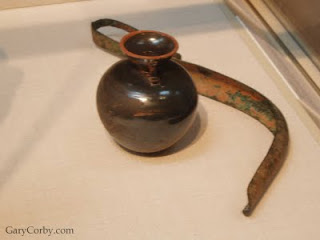
For example, say Nico goes into a bath house. Classical Greece has soap, but no one wants to use it because it's made of goat fat and ashes. Instead, a slave rubs Nico with oil and then scrapes away the dirty oil and the dead outer layer of his skin with a metal implement called a strigil. But what's a strigil look like? It looks like this:


This might be the very flask and strigil the slave used on Nico. This strigil is larger than the Roman equivalent, and note the way it's curved on the inside.

Seeing the strigil tells me lots of things, and inspires possibilities. If enemies rushed into the bath house and attacked Nico with knives, he could realistically grab this strigil to parry the blows until he can get away. No, that doesn't happen in any of the books, but now that I've seen one, it might.

It's going to take me a long, long time to catalogue everything I captured, but as I do I'll post anything that strikes me as being of general interest.

So tomorrow night I hop on a big plane to go home. It's been lots of fun in the US. Do look after the place until I can get back next year.

How to poison an intern

I've just spent a delightful week in New York, where amongst other things I met all the fine people at FinePrint Literary Agency. The lady in the middle of the picture is Joanna Volpe, who was Janet's godsend when I submitted my first book and is now a successful agent in her own right with Nancy Coffey. The others are the interns at FinePrint. Missing is Intern Mitch. (Mitch, if you send me a photo I'll put it up.)

I think it'd be fun if the interns said hello and told us something about themselves in comments. I'll edit their words into the main text.

The people in this picture are among the few who have read both my first two books, so they're miles ahead of the rest of you. I spent an amazing afternoon with the interns asking them to tell me what they liked and disliked in the books, which let me tell you was eye opening. Mostly it caused me to say things such as, "OMG I never noticed that!" with the occasional, "What do you mean you don't remember the rat joke?"

The little yellow jars on the table are Vegemite, the closest thing Australia has to a national food. In a fit of more-ethnic-than-thou, I brought five jars, which the interns tucked into eagerly.

And quickly rejected.

They now know what I meant when I said you have to spread it thinly. Vegemite is strong and salty, but full of vitamin B. Not that I'm offended, I had a feeling this would happen. I once fed some Vegemite to a Canadian who clutched his throat and choked, "You feed this to children?"

And now a word from Deirdre:
This is Intern Deirdre (far right). We all agreed it was a lot of fun discussing your manuscripts with you, so I'm glad it was helpful for you.

A little bit about me... I recently graduated from the University of Michigan with a degree in English Language and Literature, and I'm trying to break into the world of book publishing via my fantastic internship with FinePrint Literary Management and Nancy Coffey Literary and Media Representation. These people are wonderful and know EVERYTHING there is to know about books and publishing.

Thank you again for the Vegemite (even if I did give mine away to Jo)!
From Intern Cassandra. I swear this was not a paid advertisement...
We had a great time meeting you - it was so much fun meeting an author and getting to talk to you before the rest of the world sees your amazing books and propels you to J.K. Rowling fame!

I'm a huge fan of your books - I don't think they're quite like anything out there right now. I mean, Mary Renault is all well and good, but I like a little humor and mystery with my history. I urge all you readers to run out and buy the book the second it comes out - it's impeccably researched and a total page-turner.

The only Vegemite-taker amongst the lot of them was Jo, shown here eating the traditional Vegemite sandwich as per the Men At Work song of years ago.


I suggested by the way FinePrint should post pictures of their offices so people can see what a literary agency looks like, and both Peter Rubie and Janet recoiled in horror.

The Night Things Changed

So I am sitting next to my agent Janet Reid at the Macavity awards at Bouchercon. Another of Janet's authors, Dana Cameron, is up for a Macavity for her short story The Night Things Changed.

The speaker gets to the short story award and calls out the nominees. With every name I can feel Janet tensing like a spring being wound tight.

"And the winner is...Dana Cameron!"

Everyone else is clapping politely. The over-wound spring beside me has exploded. Janet has shot into the air, cheering loudly and clapping. My ears are ringing. Lots of people are looking our way.

That's the sort of agent you want to have.

Congratulations Dana!