In praise of Helen, Goddess of Punctuation

I've been deep in major edits for the last week or so, and this tends to put my head into a weird place. Just ask my wife Helen, who has to put up with me in this mode.

Helen is, of course, the perfect name for the wife of a Classical Greek mystery writer. She's my first reader for everything. I know I have a scene right when I want to read it out to her before I'm finished.

Helen is the Goddess of Punctuation. When she checks my writing, the conversation goes something like this:

Gary: What did you think of the scene?

Helen: There's a missing semi-colon on the first page, I fixed all the commas and broke up several sentences that were too long and--

Gary: No no no! What did you think about the story?

Helen: The story? Oh, it was fine.

At least, that's what used to happen. We now have a deal whereby she has to keep her hands off the text and can only comment about the story until the book's finished. Then Helen is unleashed and she fixes everything. Kathleen, Janet and Jo have all commented how clean my manuscripts are. It's nothing to do with me and everything to do with my wife.

Helen has an astonishing memory for text of any sort. She not only knows off the top of her head the phone number of everyone she's ever called, she can tell you what their phone numbers were twenty years ago too. I haven't remembered a single phone number since we got married; I don't need to when I have a walking database beside me. Helen used to do immigration law, when she could recite from memory the entire immigration act. Not only that, but the applicable law for a visa is whatever it was on the day of application, and there are hundreds of tweaks made to the rules every year. If you nominated any random date, Helen could recite what the law was on that particular day. This remarkable ability found its way into my stories.

Here is Diotima, wondering why the other priestesses are a little bit annoyed with her. Nico says:
“I suppose, when you arrived here, they asked you to learn the local prayers?”

“Every temple in every city has its own festivals and rituals and prayers. I could hardly do my job if I didn't know them.”

“Tell me, did you by any chance learn the rituals better than women who've been here for years?”

“Well...maybe,” she admitted. “The actions were a bit complex, but mostly I only had to remember some simple lines.”

“How many simple lines?”

“I don't know, I didn't count. Should I have?” She chewed on her thumbnail as she thought about it. “I did get through all the rituals for the year, plus the special events...umm, three thousand, maybe four thousand?”

“Let me guess; you had them word perfect within a month.” Diotima could recite much of the Iliad from memory. If she hadn't been a woman, she could have become a famous bard.

“Eighteen days. Practically all of it rhymed.”

“And now you're wondering why the other priestesses dislike you? Diotima, couldn't you at least pretend to make a mistake?”

“Is it my fault their memories aren't good?”
Despite her outstanding memory Helen has zero willpower when it comes to study. When we were first going out she did everything in her power to avoid studying for her law exams. This drove me up the wall, to the point at which one day I removed all the shoes from her apartment so she couldn't leave, and then left her to spend the day with nothing to do but study. When I returned that night her oven was spotless. She'd spent the whole day cleaning it.

Give me some of that old time religion

How hard would it be to practice the ancient Greek religion these days?

Yes, I'm aware there are people doing their own modern versions of the ancient worship, but I'm talking about worshiping the Gods and Goddesses as it was done back in the good old days; done so well that an ancient Greek transported 2,500 years into the future would recognise his own religion.

The answer is: very tough indeed.


To start with, if you're not sacrificing animals, then you're just not doing it right.

Sorry, but that's the way it is. Animal sacrifice is central to ancient religion but anathema to virtually anyone practicing modern paganism. I certainly wouldn't condone it; it would probably be illegal in most countries; but if you want to do religion the way the Greeks did then you don't have a choice. Every important ritual and festival required a sacrifice, and an important element was that the sacrifice "agree". It's fine to have a BBQ afterwards, but you'll need some butchering skills which aren't exactly common these days.


You need an almost encyclopaedic knowledge of Homer.

The Greeks had no Bible. Their entire written experience of the Gods came from Homer, and from another ancient author called Hesiod, who amongst other things wrote Theogeny, which defined the relationships between the Gods and Goddesses.

At heart the Greeks expected the Gods to behave the way Homer wrote them. It's as if we took our Christian viewpoint from Shakespeare.


Learn a lot of hymns and odes.

Actually this is good news, because most of them are very good. There were a whole pile of standards and favourites, which when you get down to it is the same as having psalms. The difference is you need to memorize a few thousand lines, because normal people didn't have books with this stuff written in. Not to worry, you'll have plenty of time to memorize while the building work is underway.


You need a cult statue. And a temple.

The Greeks did almost everything in the open air. Except religion. For that they built very elegant, very expensive temples. Inside each temple is a cult statue. The Greeks believed -- and I mean believed -- that the God or Goddess would inhabit the cult statue from time to time. (If a statue transforming into a God seems strange, consider the premise behind the Christian mass. It's called transubstantiation.)

So you need to get together with some friends and buy some decent land. Put a Greek temple on it. The design is very well known but it's a non-standard form these days so the material and labor might be a trifle expensive.

When you've finished the temple hire the best sculptor you can afford for the cult stature. Something ten times larger than life in ivory, gold and silver would be just great, but if that's outside the budget, you may have to settle for a lifesize marble or a cast bronze.


Did I mention you have to do one of these statue/temple combos for each God?

You don't need every minor deity, but you definitely have to cover all the majors. That's Zeus, Hera, Apollo, Athena, Aphrodite, Artemis, Demeter, Dionysus, Hephaestus, Ares, Hermes and Poseidon. Don't forget any of them; not if you know what's good for you, because these guys are known for the odd spot of jealousy, they're easily offended, and they can do serious damage. Ask any Trojan.

Witchcraft in Ancient Greece

Witchcraft was alive and well in Greece.

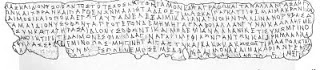
The best and certainly the most numerous examples of Ancient Greeks using magic are the curse tablets which have been found by the hundreds. They're usually inscribed in lead.


This is a curse tablet found at Pella. It says (and I paraphrase a great deal to make it readable): I call upon upon the daimones to bind the marriage of Thetima and Dionysophon, so that Dionysophon never wed any woman but me. May I grow old with Dionysophon, and no one else. Have pity upon me dear daimones, for I am alone and abandoned. Do this for me so wretched Thetima perishes miserably and let me be happy and blessed.

Such a nice lass.

Anyone could write their own curse tablet, and many did. The tablets were usually buried, often in cemetaries, or thrown into water or wells. The idea was to get the curse as close as possible to the more chthonic of the Gods. Curse tablets when they invoked a deity usually called upon Hades (Lord of the Dead), Persephone (His Queen), and Hermes Cthonius (Messenger to the Underworld). Clearly not deities you wanted to meet socially.

You could also hire a professional for all your magic needs. Plato's Republic(!) actually mentions professional magicians, of whom Plato says in Book 2, section 364C : ...and that if a man wishes to harm an enemy, at slight cost he will be enabled to injure the just and unjust alike, since [the magicians] are masters of spells and enchantments that constrain the gods to serve their end.

Apuleius in The Golden Ass calls Thessaly the land of magic and witchcraft.

A Greek witch was called a pharmakis, from which we have pharmacist and pharmacology. Their basic job was herbs, medicines and poison. The odds are very good that a sick person might go see the local witch woman rather than an expensive doctor. The brilliant historical writer Mary Renault mentions this in The Praise Singer. She has the poet Simonides explain his great old age by saying whenever he fell ill in a strange town he avoided the doctors and asked for the local wise woman.

There was a hazy zone between between Gods and Goddesses and normal humans. In between were many demi-god half-breeds who had special attributes on account of their divine side, but who nevertheless were mortal. I don't think they count for real witchcraft but some of them are very witchy.

Circe was either a witch or a minor Goddess, depending on which version you read. Either way, she had a tendency to turn people into animals.

Medea was an outright witch and used ointments and potions to both poison and heal. She is often described as a priestess of Hekate, but I suspect it's a later association. The Goddess Hekate is worth a book, but the grossly over-simplified story is she's associated with witchcraft and the darkness, potions and poison, and is almost certainly pre-Greek.

Hekate is the only Goddess whose priestesses might automatically be considered to practice witchcraft, though even in their case it's unclear. Other priestesses had no magic power of their own. They did their work through sacrifice and prayer, asking the Gods to intercede, or in the case of the Pythoness at Delphi, acting as a conduit. There was a world of difference between a priestess and a witch.

I have a scene in one of my books in which a witch woman appears. I'd love to quote it to you, but unfortunately it would be a huge spoiler.


Thanks so much Amalia for the idea of writing this.

Change of comment policy

After a comment by Carrie on twitter and the resulting feedback I'm going to change the comment policy on the blog.

Word verification is now off. This is an attempt to improve the reader experience, because it seems captcha is annoying people a lot.

I have not turned moderation on. This is an experiment to see if I get hit with spam. If I do, moderation will have to go on because I really don't want the spam.

Please let me know what you think works best!

The hermae, and mutilation thereof

This is a herm...


and this is another herm...


A herm was a bust of Hermes, who as you surely know was the Messenger of the Gods.

Athens was riddled with hermae. There was a herm at every cross-street in the city. Many houses installed a herm outside their front door. In the Agora was a platform with a hundred or more of them.

Hermes, as Messenger of the Gods, was protector of travellers. By placing his bust anywhere a traveller might pass, the superstitious Greeks were doing their best to protect anyone out on the streets.

Interestingly, Hermes was also protector of thieves, presumably because as an occupational hazard thieves often need to travel quickly at short notice.

In Athens these busts would have been set atop a short pillar, head height at most, and if you looked to the base of the pillar you would probably have seen the carving of an erect phallus pointing up at you, another symbol of good fortune.

These pictures are from the Met., Roman copies of Greek originals, and they are very good quality indeed compared to most hermae. Think of all the cross-streets and houses in Athens: there were thousands of these hermae. Top sculptors would have reserved their valuable time for more profitable work. Probably most hermae were churned out by low-end sculptors and journeymen learning their trade.

One morning in 415BC, Athens awoke to discover every herm in the city had been damaged. Someone had obviously gone about the city overnight destroying all the divine good luck symbols, and considering the many hundreds of hermae involved it could only have been a calculated act of sabotage. This incident has gone down in history as The Mutilation of the Hermae.

Athens was paralyzed with fear. This wasn't mere sacrilege; to most people the Gods were as real as a smack in the face, and a God's cult statue was a place the God could inhabit. The mutilation of the hermae was like kicking the God Hermes in the balls a hundred times over.

The Athenians expected direct and dire divine retribution at any moment. A frenzied search for the culprit began at once. In the panic it only became necessary for someone to suggest a culprit for the accused to be arrested, and more than one of these unlucky men were executed, but the panic went on. Fairly soon debtors were accusing their creditors as a novel means of debt cancellation.

Then suspicion fell upon a fascinating scapegoat: Alcibiades, the first cousin once removed of Pericles. Indeed Pericles, though dead by this date, had been legal guardian of Alcibiades as a child. Alcibiades was brilliant, daring, wealthy, handsome, clever, opportunistic, egotistical, dissolute and utterly self-serving. This was the sort of insane thing Alcibiades might do for a joke.

Now Alcibiades was guilty of any number of crimes in his life, but this probably wasn't one of them. Nevertheless the mud stuck, and even though by then he'd departed to lead an invasion of Sicily, he was recalled to stand trial.

Alcibiades wasn't a complete moron; he turned tail and ran, straight to the Spartans with whom Athens was at war. In revenge, Alcibiades advised the Spartans how best to defeat Athens, and his advice was good.

And so the bad luck of the mutilation came to pass, because the man charged with the crime contributed to the downfall of Athens.

It must be added Alcibiades changed sides again later, and Athens took him back before expelling him once more. If he were alive today, Alcibiades would be a junk bond trader, or a used car salesman, or a world leader, or possibly all three at once.

The real culprit of the Mutilation of the Hermae and the motive for it remains ones of the ancient world's greatest unsolved mysteries.