Pericles on how allies work together

In these days of NATO and the United Nations, I thought it might be interesting to look at Pericles' view on how well equal alliances work.

This is from Thucydides, book 1, section 141. The Athenians have met to decide whether they should, in effect, initiate a war against the Spartans. If they do, they'll have to fight not only the Spartans but the entire alliance of the Peloponnesian League. Pericles says this about the allies of Sparta:

"...they cannot fight a war against a power unlike themselves, so long as they have no central deliberative authority to produce quick, decisive action, when they all have equal votes, though they all come from different nationalities and every one of these is mostly concerned with its own interests -- the usual result of which is that nothing gets done at all, some being particularly anxious to avenge themselves on an enemy, and others no less anxious to avoid coming to any harm themselves. Only after long intervals do they meet together at all, and then they only devote a fraction of their time to their general interests, spending most of it on arranging their own separate affairs. It never occurs to any of them that the apathy of one will damage the interests of all. Instead, each state thinks that the responsibility for its future belongs to someone else, and so, while everyone has the same idea privately, no one notices that from a general point of view things are going downhill."

There seems to be a general view amongst professional historians that the speeches in Thucydides are not to be trusted, particularly the speeches known as the Melian Dialogue, which could have taught Machiavelli a thing or two about realpolitik. (In fact, they probably did.)

Unlearned me goes against the learned opinion on this. I find it difficult to read something like the above without nodding my head and thinking, yep, that came from an experienced and cynical politician who knew what he was talking about.
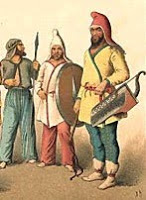
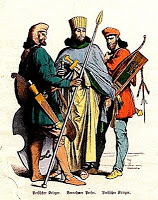
The trousers of doom

Trousers, as in, long pants that cover the legs, appear to have been invented more or less simultaneously and more or less independently in Persia and Scythia. We can see in figurative decorations that the styles were quite different, but men commonly wore trousers in both places.

This might be because the men of both nations spent a lot of time on horseback. Since stirrups hadn't been invented yet, horseriding in a Greek chiton must have been eye-opening, even with a rag to wrap up the goodies.

Nevertheless the Greeks never had any time for trousers, who thought them weird and laughable, and associated them with the hated enemy. A Greek who copied Persian dress could expect heckling at best. Not even Alexander the Great was spared when he copied the Persians.

And therein lies a problem for poor Gary.

My second book includes a man who wears trousers. But I am reliably informed that trousers is not the most common word in the US, where pants is preferred. For the rest of the civilized world, pants means something quite different.

Incidentally, this means that when an American describes a writer as a pantster, it conjures an image in British readers that certainly wasn't intended.

I confess my mind rebels at the thought of calling them anything but trousers, but I can repress revulsion long enough to do a global replace if necessary.

What do you think? Will the Americans cope with trousers? Or shall my character wear pants?

Pelops vs Oinomaos: the first Olympic chariot race

In the middle of the Sanctuary of Zeus at Olympia was a ruined building. The Greeks believed that this was the megaron of King Oinomaos, who was a very ancient king of the dark ages. A megaron was a Greek king's court in prehistoric times. Literally: mega (great) ron (hall).

Beside the megaron was a large burial mound, enclosed within a wall of five sides. This was believed by everyone to be the burial mound of the hero Pelops. The hero-king for whom the Peloponnesian Peninsula is named.

According to legend, King Oinomaos had a daughter, a girl of great beauty, by the name of Hippodamia. Oinomaos had no sons, so whoever married Hippodamia would inherit the rule of the land. (The usual set up).

Needless to say, a great many unsuitable men asked for the hand of the beautiful Hippodamia, so many that it became an irritant. Oinomaos developed a way of discouraging suitors. He challenged them to a chariot race. If Oinomaos won, then he killed the foolish suitor with his bright spear. But if the suitor won, then the suitor would marry the girl and become heir to the kingdom. Many men died in the pursuit of beauty and wealth.

Note that the name of the princess Hippodamia means Horse Tamer.

Then the hero Pelops asked for the hand of Hippodamia.

Luckily for Pelops, Hippodamia fell in love with him. (The usual setup again.) The only problem was, daddy was the best chariot driver around, so Hippodamia bribed her father's charioteer, a man by the name of Myrtilus, to remove the linchpins from the wheels of her father's racing chariot. His reward if he did so would be half the kingdom, and the first night in the bed of Hippodamia.

And so the race was arranged. Pelops surged to the lead. But the chariot of Oinomaos made ground.

Oinomaos raised his spear to slay Pelops as they raced, when at that moment the wheels of his chariot flew off. Oinomaos was dragged to his death.

Pelops married Hippodamia, became King at once, and they all lived happily ever after. Except for Hippodamia's father, who was somewhat dead.

Myrtilus reaped the usual harvest for treachery: Pelops murdered the fellow when he was brazen enough to claim his reward.

This was considered the first Olympic chariot race, though it certainly wasn't at the Olympics, and it was won by cheating and sabotage. The race between the hero and the king was displayed on the outer pediment of the Temple of Zeus at Olympia.

Myrtilus was buried under the taraxippus at the east end of the chariot race arena. It's the reason the Greeks believed there were so many accidents at that turn. The psyche of Myrtilus, who was both murderer and murdered, remained to terrify the horses.

Four horse chariot race: the Formula 1 of the ancient world

The four horse chariot race at the ancient Olympics, and later at the circus maximus in Rome, was the Formula 1 of the ancient world: fast and dangerous.

The chariot races were the first major event on the schedule of the ancient Olympics. The Greeks liked to start things with a bang. Unlike modern races, the chariots did not race in an oval. They went about two turning posts, more like a modern yacht race since everyone had to squeeze around the same post at about the same time. Given the width of four horses, this added to the chaos and the danger.

The turning post at the east end had a special name. It was called taraxippus, the Horse-Terror, because this was where most crashes occurred. The reason for the particular danger was said to be the nearby altar, under which was buried either King Oenomaus or his groom Myrtilus, depending which version of the legend you believed. The fact that at the taraxippus the drivers had to stare into the sun probably helped too.

Crashes were frequently fatal. When the drivers lined up for the race, they would have looked left and right at their fellows, and known that at least a few of them would be dining in Hades that night.

Roman chariot drivers wrapped the reins about their arm or body, so if the chariot disintegrated beneath them then they were dragged. Roman drivers carried a sharp knife to cut the reins, but that of course required being conscious. Greek drivers on the other hand held the reins only by hand and therefore could let go.

I am most indebted to Meghan for saving me from error here. In the original version of this post I had both Roman and Greek drivers wrapping reins, which is totally wrong. I'm very lucky to have such knowledgeable readers. Thanks Meghan!

The Romans put a solid spine down the middle of the track, whereas the Greeks had open area between the turn poles and were exposed to head on collisions. Which didn't necessarily make the Roman track all that much safer. In Ben Hur during the famous chariot race, one chariot bounces off the central spine with disastrous results.

The first official semi-pseudo-mythical chariot race in the Olympic area was between King Oenomaus and his future son-in-law, King Pelops (for whom the Peloponnese is named). This race ended in a negative experience for Oenomaus. Weirdly, and this is how I managed to get it wrong in the original, not that it's an excuse, most accounts of King Oenomaus have him being dragged to death by his horses. Maybe in the early bronze age they wrapped the reins and then the fashion changed? Or maybe, like me, later writers transposed the Roman practice into early Greece?

The location of the Olympic hippodrome is unknown today. The athletics stadion remains but the hippodrome was washed away in a major flood in mediaeval times. My guess is it was to the south, and perhaps slightly to the east, of the stadion. There's a a nice large unoccupied space there that would have been about right.

The chariot was light, barely strong enough to carry a man. There really were four horses hitched in a row.

The chariot race from Ben Hur is relatively accurate, especially the way they race from end to end. Whipping one's opponents was totally within the spirit of things. The modified wheels designed to wreck opponents in the movie would have been cause for instant disqualification, at the Olympics at any rate. And of course, the Olympic race was far more utilitarian than the ornate affairs at the circus maximus.

The starting line as in Ben Hur is totally wrong for the Olympics. The Olympics had the first mechanical starting gate in history, which was designed to make sure everyone had an even start. It was called the Hippaphesis. But I'll save that remarkable device for another post.


And if you think it can't be that wild and dangerous these days, I can't resist adding this clip from the Formula 1 race at Valencia this year.


I watched this race as it happened, and when the car went airborne I was sure I was about to see someone die. But Mark Webber walked away with only a few bruises! The engineers who make these cars could teach the commercial manufacturers a thing or two about how to design for safety by default.

The winner of the chariot race was not the driver, but the owner of the team. Rather like today there is a constructor's championship for the organisation which makes the F1 car which wins the most points. Also like today, owning and running a four horse chariot team was every bit as expensive as modern cars. You had to be the equivalent of a multi-millionaire to even think about entering. Alcibiades, the second cousin of Pericles, in 416BC entered an incredible 7 teams, which would have bankrupted some entire cities. He scored first, second and fourth.

Because the winner was the owner and not the driver, the first woman in history to win at the Olympics in any event was Cynisca, the daughter of King Archidamus of Sparta, who won the chariot race not once, but twice.

Time Manner Place

I've begun the second draft of writing Sacred Games, which is book 3 of the Hellene Mysteries. This book's set at the ancient Olympics, and will by coincidence appear in the same year as the London Olympics, always assuming the Publishing Gods are kind to me.

By no means can it be said that I have a book (yet). There are gaping holes where I wrote put some description here, or Maybe this should go somewhere else? or I broke off mid-sentence and began a different scene when I realized during the first draft that I didn't know what I wanted to say next, or I wrote in three different and entirely contradictory plot summaries without at any time actually writing something useful. Despite which, this first draft feels more complete than the ones I did for the first two books.

The act of rebalancing sentences as I revise caused me to think of something I've never seen blogged about, this interesting rule of writing: Time Manner Place.

Time Manner Place is a rule in linguistics which says that in a sentence, you should write when the action happened, followed by how it happened, followed by where it happened.

"Thirty years ago, on the Ides of Octember it was, on a dark and stormy night, with the wind howling and the shutters banging, in a small cottage in the hamlet of Pevensey, a child was slain."

The interesting thing about Time Manner Place is that this is German syntax. TMP is most common in German, which is why I know about it, and any other language which puts its verbs to the end of the clause.

The more common structure in English is Place Manner Time.

"A child was slain in a small cottage in the hamlet of Pevensey, on a dark and stormy night, with the wind howling and the shutters banging, thirty years ago on the Ides of Octember."

When I have trouble making a sentence sound right, more often than not I head for Time Manner Place. TMP is noticeable in two distinct genres of English fiction: fantasy (epic or otherwise), and mediaeval and ancient historicals. Because English belongs to the Germanic family, Old English and Middle English books are more likely to use TMP, so anything which apes Germanic syntax is likely to sound old even if the words are modern.