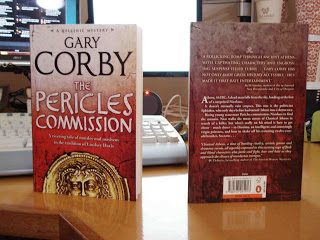
Not that I'd be one to boast—no, of course not—but the Richmond Times-Dispatch has this terrific review of Pericles Commission.
Here's the full text:
For what it's worth, my observation is that nowadays a large number of historical mysteries use real historical characters, and a noticeable proportion refer to real events. It's harder work, but it's very rewarding.
Maybe an even greater number borrow fictional characters to use as detectives, or use real authors as detectives, or other deliberately out-of-place famous people. They're the ones I'd be less sure about. It's nice having the shock value of, say, Joan of Arc as your detective, but very, very difficult to maintain across a novel. If you're to do something that stretches credibility, it has to be for a good reason that makes sense in story context.
I've been quiet on the blog in the last couple of weeks because I have almost...almost...almost...finished book 3. I keep telling my wife it'll be finished tomorrow.
Here's the full text:
Basing a novel on a real-life case isn't a new form of fiction -- and not always a successful one -- but Australian writer Gary Corby tells a crackerjack story in his debut mystery.
In 461 B.C., reformer Ephialtes was murdered in Athens, and it's from that killing that Corby fashions The Pericles Commission (335 pages, Minotaur Books, $24.99), a happy melding of historical figures with fictional characters.
When Ephialtes' body falls from above and lands at the feet of 20-year-old Nicolaos -- the fictional son of the sculptor Sophornicus and the older brother of Socrates -- Nicolaos is given a commission by the politician Pericles to find the killer.
Nicolaos has no desire to follow his father's profession and instead wants to rise to Athenian leadership. As he investigates Ephialtes' murder, he discovers a hotbed of political intrigue involving ideology, ambition and corruption. But he also wonders whether the motive for killing Ephialtes might be more personal. And amidst his pursuit, as the bodies pile up, he finds himself falling for Diotima, the dead man's daughter by the courtesan Euterpe.
Corby makes his story sing, with a fascinating plot and well-executed characters both real and fictional. And rarely has Greek history been more accessible to the layman.
For what it's worth, my observation is that nowadays a large number of historical mysteries use real historical characters, and a noticeable proportion refer to real events. It's harder work, but it's very rewarding.
Maybe an even greater number borrow fictional characters to use as detectives, or use real authors as detectives, or other deliberately out-of-place famous people. They're the ones I'd be less sure about. It's nice having the shock value of, say, Joan of Arc as your detective, but very, very difficult to maintain across a novel. If you're to do something that stretches credibility, it has to be for a good reason that makes sense in story context.
I've been quiet on the blog in the last couple of weeks because I have almost...almost...almost...finished book 3. I keep telling my wife it'll be finished tomorrow.