Ophelia

If you're a writer yourself, you probably know how some characters just seem to have certain names that feel right for them. I'm dealing with one of these at the moment, as I write my fourth book. She keeps telling me her name is Ophelia.

(The fact that I'm talking about figments of my imagination as if they had independent existence probably tells you something about my mental state, but that's another issue.)

There's only one problem: was the name Ophelia used in ancient Greece?

This is a good example of how much tougher things can be for we poor historical authors. Any contemporary novelist would just use the name and be done with it, but I have to make sure I only use names that can be verified in use for my period.

So this is the perfect opportunity to show you another example of what book research can be like. (Ages ago I did another book research post, and used as my example whether Alexander the First of Macedon competed at the Olympics of 460BC.)

As it happens, Ophelia is Greek. It comes from ophelos which means help. Ophelia is a female assistant. Case closed? Absolutely not. Plenty of Greek words were never used as names. You probably don't know all that many people whose first name is Helper or Assistant.

A quick search revealed that Ophelia does not appear as a name in any of the classics. Yes, that's a quick search. Thank you, Perseus Digital Classics.

So I did what any sensible person would do. I asked twitter.

Both Elisabeth Black and Seth Lynch came back with the news that the name Ophelia was invented in 1504 by Jacopo Sannazaro for a character in his poem 'Arcadia'. Thanks to them both for finding that!

It's not looking good for my poor non-Ophelia. But as I pointed out a few weeks ago, you can't trust information on web sites. I'm fairly sure Elisabeth and Seth have found the first English usage, and clearly the web site doesn't know of any ancient use, but that doesn't mean it isn't there.

As Sarah Eve Kelly pointed out on twitter, I needed to try fuzzy spellings of Ophelia. Sarah Eve is not only an excellent writer, she's also a PhD student in mediaeval history. She knows all about the joy of variant spellings.

So next move is to trawl the inscription and name lists. Name lists are mostly harvested from the same classics I'd already searched. But there are also books with lists of inscriptions and names taken from funeral stele, so all was not necessarily lost. Oxford University's done a particularly good job at collecting such things.

And there I found that these names have been lifted from inscriptions:

Ophelandros (appears twice)
Ophelion (appears twice)
Ophelon
Ophellios
Ophelleis
Ophellas (appears twice)
Ophelima

But no Ophelia. Nevertheless, these are all cognate, even the Ophelandros, because it's two words stuck together; the andros ending means man. The really good news is the appearance of Ophelion, because that is precisely the male equivalent of Ophelia.

So now we've entered a grey area. There's no known Ophelia, but there's the male version. Am I okay? I think I am, but not as okay as I'd like to be. We certainly don't know every name that was used in ancient times -- all we have to work with are surviving books and bits of stone with writing on them -- on the odds, Ophelia was an ancient name.

I guess I blew away about five hours nailing down that point. And of course, I could still be wrong.
Hint fiction

In the last week I helped judge a hint fiction contest on the short-short story site Rammenas. The definition of hint fiction is a story in 25 words or less that hints at a larger story.

I wrote the judges' report. If you want to see what happens when Gary has to judge someone else's writing, you can read it here. That report was dangerously close to the blind leading the blind, but it was interesting to be on the other end of the critique analysis, just for a change.

It was also terrific fun working with fellow judges Martin Hingley (follow the link if saxophones are your thing) and Marcel Warmerdam. All three of us are 40+ males who've worked in IT. When we talked over skype it sounded like an IT analyst conference.

In the end we couldn't decide between two excellent entries, so they both won. I hope I'll be forgiven if I repeat them here:
Found, by Lisa Vooght
John,
Found your USB drive in the desk. Beautiful photos, touching music selections. Curious as to the 2 obituaries. Mine and yours? What gives?
(There's a link to Lisa's blog on her name, but I don't think it's showing.)
Strangers, by Mike Jackson
We both entered the shop together, total strangers. I wanted milk, he wanted money. I had a credit card, he had a gun.
(Update: I've popped in a link to Mike Jackson's blog.)

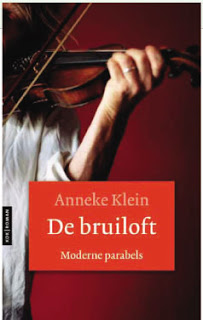
Rammenas is an English/Dutch site run by Anneke Klein, who I am overjoyed to say has her own book of short stories on the way. Here's the cover draft!

Why literary criticism works

Aven McMaster is @AvenSarah on twitter, and the Aven who comments on this blog from time to time. I think she's probably most famous on these pages for her fascinating and perceptive comments in a previous blog post I wrote about Why America is more like Athens than Rome.

Aven is a for-real professor of Classics. It was our very fun conversation on twitter that inspired me to write the previous post about literary criticism. I sat in the comfort of my office tweeting away, while she walked back and forth in a dark room in the middle of the night with a crying baby in her arms and tapping the keys of her iPhone in defence of literary criticism, with whatever spare digits weren't required to look after the baby. I begged her to write this guest post under slightly less restrictive conditions. Here's Aven:

A few disclaimers, off the top. First, as a professor of Classics specialising in Latin poetry, I am a literary critic by training and profession; so I of course have a vested interest in thinking it’s of value! I’m also not an author myself, although I do write an awful lot in my job. Second, the field covered by the term “literary criticism/analysis” is vast, and while I find some approaches very useful, interesting, and important, I find others ludicrous, boring, and even harmful. So this won’t be an exhaustive and systematic defence of every literary critic out there! And finally, I am not specifically defending literary analysis as taught in schools – first because that varies so widely with time, place, teacher, etc., and also because I, too, have misgivings about many ways that people are put off literature as kids.

It seems to me that there are at least three separate, though related, aspects of “literary analysis” that are worth discussing here. I’ll deal with the easiest to defend first. I suspect that a group of writers will be sympathetic to the project of dissecting good literature as a means to figure out the mechanics of good writing, and to learn how to write well oneself. Of course such close analysis of text is not the only way to learn the craft of writing – the best and most important method as far as I’m concerned is to read, read, read, read, read – but it can definitely help. It may not be very exciting – especially for young readers – and so may not be the best way of getting people to appreciate literature; but I do think it’s a valuable type of analysis.

A related purpose of close analysis is important, I think, not only for aspiring writers but for anyone who wishes to have as good an understanding of the world as possible. Every writer (and speaker, for that matter) uses a variety of tools to provoke emotion, convey details, persuade, argue, etc. A close analysis of these techniques may be interesting for its own sake, but it is even more important in helping us understand how we are being manipulated and affected by every written and spoken communication made to us, both now and by historical sources. Such things as seeing how the genre of a work affects the content, for instance, are crucial to understanding the value of historical sources as evidence – can we read the description of a battle in Herodotus the same way we would read a war correspondent today? What about a speech by Pericles, reported by Thucydides? Or a poem by Horace, describing a temple in Augustan Rome? We all know that those texts will all have a different relationship to “the truth”, but how can we get close to figuring it out? The more we understand about the context of the text, its relationship to other texts, its generic conventions, the use of metaphor, the author’s purpose (insofar as it can be known), the audience’s expectations, the rhetorical techniques, etc., the better we can “use” the text for whatever our purpose may be. (And, for the record, all of those things are important for understanding the relationship between any modern text – from the newspaper to a politician’s speech to a tv documentary – and “the truth”!). In this way, then, critical thinking and critical reading, and a thorough understanding of literary critical method, is crucial to good history and (if it’s not too grandiose to say!) to informed participation in the world around us.

Ok, but what about the Rorschach Test aspect of this? What about the question of the author’s intentions, and the critics who say that they don’t matter? Well, I’m not a New Critic, and in fact most of my own work is strongly historicising – I try to figure out the historical context and the significance of certain concepts, ideas, terms, images, etc. in the poetry I study. However– as I tweeted to Gary in our conversation, even if I could ask Horace or Catullus anything I wanted about their poetry, and could get an answer, I wouldn’t necessarily feel that I knew everything there is to know about their works. I do firmly believe that the author, although (my joking tweet aside) AN expert in his or her own work, is not THE expert. Let me try to make my case with a few examples. Say that I was reading The Pericles Commission and found some passages or ideas that I thought were similar to something in, oh, I don’t know – Agatha Christie’s The Third Girl (to pick a somewhat more obscure novel of hers). (I haven’t, btw!). And let’s say I asked Gary about this similarity. He could give one of three answers: a) oh yes, I did that on purpose, for X reason; b) oh, I hadn’t noticed that! I read that book a long time ago, but I certainly wasn’t thinking about it when I was writing; c) that’s strange, because I’ve never read that book!

Now, whatever his answer, it’s still an interesting discovery. If he says a), then we’ve learned something about the process of writing, for Gary at least, as well as something about how one text or author influences another. If he says b), then we’ve learned something different about Gary’s writing process and the influence of previous authors. If he says c), then we’ve learned something about the kind of tropes, conventions, and patterns of detective novels, and perhaps even about how the human mind works, or at least about how storytelling works. His intentions, then, are relevant – but don’t determine whether or not seeing that parallel was a “valid” discovery.

Or another example: say after Gary’s next few books have come out, I find that all of them explore, in one way or another, good and bad parental relationships. And say I ask him about this. Again, he might say “Oh, yes, I find that a fascinating part of human life” or “Yes, I guess I’m thinking about my own family relationships”, and we could then find that interesting, and feel that it added to the weight of his books for us. Or he might say “Really? I never noticed that. I certainly didn’t try to do so”. Does that answer mean that I am wrong? Even if every plot contains a father and a son, say, and every novel has a parent/child argument and a parent/child reconciliation? (Again, this is all hypothetical! Sorry Gary!). Or does it still enrich my reading of the novels, and potentially enrich the readings of other people, if I tell them about my discovery?

On that last point I’ll have to let you decide. Ultimately we each have to take our own approaches to texts; and I certainly do not think that there is only one “right” interpretation, or only one correct approach. But for me, at least, looking for layers of meaning, symbolism, relationships within a text and between different texts, enriches the experience of reading good books. And while I do find it interesting to know what an author was thinking, and for some aspects of understanding the text, crucial (at least to know as best we can), I also can find my appreciation of a text deepened and improved even by noting things that the author didn’t intentionally include.

I’ll end with some of what I tweeted at Gary originally:

“If texts only contained the deliberate & conscious thoughts of their creator, they'd be much less interesting, and, frankly, unique among human communications! Nothing we say or do is that simple.”

Thanks Aven!


Literary analysis: is it a Rorschach Test?

Here is a somewhat edited version of a conversation on twitter between me, AmaliaTD and AvenSarah, both of whom grace these pages from time to time. It began with me retweeting something that might be an urban myth:

Gary: Alfred Hitchcock once helped his granddaughter write a college paper on his film SHADOW OF A DOUBT. His analysis earned her a C.

AmaliaTD: That really doesn't surprise me at all, but it's still hilarious.

Gary: It shows how totally overdone is critical analysis. Somewhere in the afterlife, Shakespeare is laughing his head off.

AvenSarah: Or that authors are not experts in their own work. ;)

Gary: That's the English Department rationale for why literary criticism should be taken seriously! I confess I'm not convinced. There's the Rorschach Test Effect of people seeing things in a story that the author certainly didn't anticipate, but that's identical to seeing interesting shapes in clouds. The clouds didn't intend to look like a bunny rabbit.

Your turn! How do you feel about all those meaningful essays you wrote at school? Feel free to tell me how totally wrong I am.

Akropolis, by von Klenze

Leo von Klenze painted in 1846 this idealized view of the Acropolis in the time of Pericles. I'm glad the title includes the word "idealized", because there are a few things wrong with the accuracy. Even so I suspect it does a terrific job of capturing the feel of what it was like back then, especially the Parthenon and the walk up to the Propylaea. That's the building you see smack in the middle, with the steps leading up to it. The mega-statue rising from behind the Proplyaea can't possibly be real.


I can't believe the Areopagus -- that's the rock platform in the foreground where the crowd is milling about -- was ever as flat as von Klenze has it. If you visit today you'll see that the Areopagus is very up and down in its top surface, and I doubt it's all due to wear. Also, there's no way there was ever an ornate marble building on top as shown at the left. I do think there was a large wooden structure for meetings of the Council of the Areopagus. But this is all carping. The point is, he captured the spirit of the place.

This picture is interesting to me because in the center of it is where I killed my first victim, on line 1 of my first book: