Two reviews from interesting sources

Two new reader reviews:

Review number 1 is for The Pericles Commission.

What makes this interesting is that it's reviewed by Alun Salt, who's a for-real archaeoastronomer, which has to be one of the cooler job titles around.  Alun helped me out with some dates for the third book, because the ancient Olympics was scheduled to run according to various phases of the moon around the summer solstice.  So he was able to give me information on how much light there would have been to see by at the time of the murder.

Alun's done some very interesting research on the placement of Greek Temples relative to the sun, which I blogged about some time ago.

So Alun looked at my first book very much from the viewpoint of someone who knows the period in minute detail as a professional.  Here's his review.

He raises quite a few points that I haven't seen elsewhere.  I won't clutter this post with detailed talk about them.  Only insane authors argue with reviews, and in any case there's nothing to argue with, but I'll definitely be back to discuss some of the things he mentions in a later post.
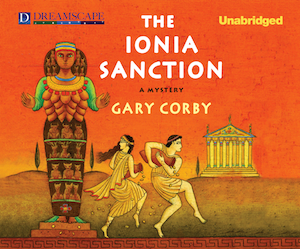

Review number 2 is for The Ionia Sanction.  But not the book; it's for the audio version.

Dreamscape is an audio book producer in the US.  They hired an American actor to read the book end to end.  I hope he liked it, because he had to read every word very clearly!

The audio version of The Ionia Sanction is now for sale, and thanks very much to Dreamscape for doing it.

The audio review was written by Bernadette at Fair Dinkum Crime, who very clearly is not American, and I was interested to see how that affected the listening.


Dead Bolt

Some time ago I wrote about finding one of the books of a US author friend in a resort town in New South Wales, in Australia.  Someone must have bought the book in the US, carried it to Oz, then left it in an obscure place, only to be found by someone who happened to know the author.  A weird coincidence.

Said author was Juliet  Blackwell, whose latest novel Dead Bolt just made #24 on the NYT bestseller list.  Dead Bolt's the second of her Haunted Home Renovation mysteries.  So if you're into paranormal home improvements, this is the book for you, and a lot of people think exactly that.

Yay for Juliet!


Colloquial ≠ Anachronistic

I've previously talked about voice in ancient mysteries, but I want to add a bit to it, because this subject comes up surprisingly often.

It's a current trend in historical fiction to write in a more colloquial voice than you would have seen in the equivalent fiction of, say, 50 years ago.  That's a trend to which I'm contributing.

Interestingly, if you go back in time 100 years or so, the colloquial trend reappears.  If you look at Sir Arthur Conan Doyle's excellent historical novel The White Company, which is about mediaeval knights, you'll find the characters speak in perfectly colloquial Victorian English.  (Conan Doyle wrote both mysteries and historical novels...he just didn't do them at the same time.)

But in between Conan Doyle and the modern age, virtually every good historical novel speaks like a graduate of Oxford.

That's because in the mid-20th century, virtually every good historical novel was written by a graduate of Oxford.

A classic example (classic in every sense) is Mary Renault, who wrote the best novels of ancient Greece ever.  Guess what?  She went to Oxford.

I think what happened is, the Oxford voice was so common across quality work that it became the expected standard.  Therefore, in the minds of many people, any voice that doesn't sound formal must be in some sense wrong.

Anachronism means putting something into a story that could not possibly be there, because it's a forward reference in time.  If Diotima said something clever (as per usual), and Nico replied, "Good thinking, 99."  Then you could legitimately reach for a high powered rifle and go in search of the author.

But as long as there are no forward references, then any choice of voice is anachronism-free.  Different voices will appeal to different people -- that's a pure matter of taste -- but by no means is colloquial voice anachronistic by definition.

In my case, I'm translating what my characters said in modern, everyday, colloquial Attic Greek, into what my readers understand, that being modern, everyday, colloquial English.  I'm afraid Nico didn't go to Oxford.  Nor did I, for that matter!

Which raises the other big trend that I want to point out: historical novelists are no longer classics graduates.  At least, not necessarily.  This is guaranteed to have a big effect.  If the author's any good, he or she will be solidly grounded in classics, but not coming from the same homogeneous environment means we'll increasingly read diverse views of the ancient world, that simply could not have happened 50 years ago.  The trend to colloquial voice, likewise, will make the ancient world accessible to people who otherwise would never have opened an ancient history book.  All in all, it's an opportunity for ancient-period novels to really grow.


The Page 69 Test

The third and final, but not the least, of Marshal Zeringue's book blogs.  I love the idea of this one.  Marshal asks authors to write about whatever happens on page 69 of their book, and whether it's representative of the rest of the book.

Of course, since there should be nothing in a well structured story that isn't absolutely necessary, it'd be a major problem if someone could write that a page had nothing to do with the story!   Marshal has piles and piles of book entries where authors have talked about their page 69.  They're worth a look.

A killing financial problem

Sometimes, it just sucks to be an accountant.  Back in classical Athens, there was a group of ten city officials, elected yearly, called the Hellenotamiae.  They were the official city treasurers, their job to manage the money vault buried beneath the Parthenon.  The sums they handled were vast.

The Athenians, being the untrusting souls they were, checked the accounts on a regular basis.  On one occasion, the numbers didn't add up.  The ten treasurers were instantly charged with embezzlement.

This is what happened, from a surviving court case that mentions this unfortunate incident as a precedent:
Then again, your Hellenotamiae were once accused of embezzlement... Anger swept reason aside, and they were all put to death save one. Later the true facts became known.
This one, whose name is said to have been Sosias, though under sentence of death, had not yet been executed. Meanwhile it was shown how the money had disappeared. The Athenian people rescued him from the very hands of the Eleven, while the rest had died entirely innocent.

The Eleven was the official Athenian body responsible for carry out state executions.  In other words, Sosias had been in the hands of his executioners when they retrieved him.  The implication of the "it was shown how the money had disappeared" is that it was a mistake in the books.

So the other nine treasurers died for an accounting error.