The Wedding

Something's happened that is long, long overdue.  Anneke Klein has finally written a book.

Anneke is an excellent writer, and as you can probably tell she's an excellent writer in Dutch, that being her native language.  De Bruiloft means The Wedding.

What's remarkable is that she also writes fiction in English, and critiques in her second language.  Anneke's been one of my beta readers since long before The Pericles Commission was a gleam in any editor's eye (which means she knows what happens in book 3).  She's so good at critiques that I've been prodding her for ages to take up manuscript assessment as a  paid job.

Fortunately Anneke ignored me and instead wrote The Wedding, and I couldn't be happier that she's in the print that her talent deserves.

The books that changed me

The Sydney Morning Herald's Sunday edition runs a regular piece called The Books That Changed Me.  Each week, an author nominates five books they think important, and the reasons why.

I'm very happy and privileged to say that this week it was my turn to give it a go.  It's part of the print edition but they also put it online.  If you'd like to see what I picked for the five books that changed me, it's all over at the Sydney Morning Herald.

(My author photo is right next to an author shot of Colleen McCullough...OMG)


Drink like a Greek: wine cups

Ancient wine was quite unlike the modern stuff.  To start with, they added spices, such as fenugreek, which these days you're more likely to find in a curry. They also added seawater, for a very good reason. In a world without sulphur, salt makes the next best preservative.

Wine was always drunk with water mixed in.  No exceptions, not ever.  To drink wine neat was the mark of the worst sort of dissolute barbarian.  The usual ratio was three water to one wine.  Since water filtration plants hadn't been invented yet, the practice might have begun so the alcohol could kill any bugs in the water.  The water and wine was mixed together in a large jar called a krater, and then served out into cups.

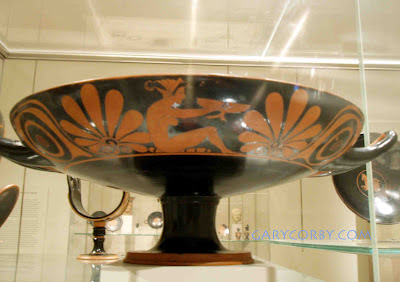
Wine at a party was served in a very wide, very flat cup called a kylix.  Here's one at the Metropolitan in New York:


Yes, the decoration on the outside is a naked woman drinking from a kylix.  Some of the decorations on these things would be rated XXX.  Speaking of which, here's a decoration on the inside of a cup.  This is what you'd see after you've drunk the wine:


The lady is playing a drinking game called kottabos.  That's why she's holding her cup in that funny way.  Here are the rules for kottabos:
  1. Drink your wine to the dregs.
  2. Hold cup as per lady in picture.
  3. Throw the dregs at the nearest wall.

Winners are judged for the most interesting patterns on the host's walls, or possibly the furniture or the fellow guests if someone's a bad shot.  

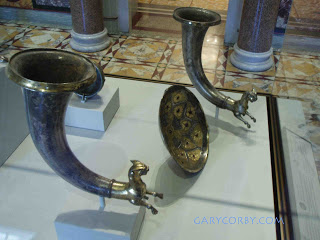
The other, more unusual cup for alcohol, is something much more associated with Vikings, but in fact comes from Persia.  The Greeks called it a rhyton, which is also the English word.  It's a cup in the shape of a horn:


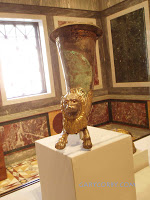
These things were always made in the shape of an animal or some similar subject.  These are at the Getty Villa in L.A., as is this lion:


In The Ionia Sanction at one point I have Nico at a Persian party where he's given a rhyton to drink from in the shape of a boar.

Drink like a Greek: water cups

Ancient Greeks drank water and wine.  Beer wasn't popular.

Water was collected each morning from springs, wells, and, occasionally, public fountains, and carried back to the home. The most famous spring in Athens was called Kallirhoe. It was a tradition to wash in the waters of Kallirhoe on your wedding day.

Most cups were as normal-looking as modern ones, but some were works of art.  The pictures left and right are of a cup in the Metropolitan Museum in New York.  It's the sort of thing you would have found in a wealthy house.

And if you think people took their art seriously back then, check out this cup:


Don't ask me how they got it to stand upright.


Such a strange concept

This review of The Ionia Sanction just appeared in the Sunday Herald Sun, an excellent Melbourne newspaper

SUCH a strange concept — a murder mystery set in ancient Athens — yet it works so well in history buff Gary Corby's second Hellenic mystery, The Ionia Sanction. 
The year is 460BC and Nicolaos, the only investigating agent in Athens, is called on by the city's leader, Pericles, to investigate the suspicious death of an Athenian official. 

But after tracking the killer and letting him slip through his fingers, Nico finds himself on his boss's bad side and desperate to make amends. 

Nico's quest to solve Thorion's murder takes him across the oceans to the Persian Empire. There he runs into his ex-girlfriend, meets the infamous Greek traitor Themistocles and uncovers a Persian plot that threatens to destroy Athens. 

This fascinating book blends historical events and figures with fiction to create a funny, gripping and satisfying mystery you won't be able to put down. 

SAMANTHA LANDY 
VERDICT  ★★★★☆ 

It occurs to me people might not know how newspaper reviews come to be.  The simple answer is: I don't have much of a clue myself.  

What happens is Heidi the Publicist, who's extremely good at this sort of thing, sends  the book out to known quality reviewers and then waits to see who's interested.  The first I hear of a review is when Heidi or some other responsible adult lets me know it's out there.  My contribution is absolutely zero, if you don't count writing the book in the first place.  I have no idea what any review is going to say until it appears.  

Reading your own reviews is a slightly nervous process; I read the first paragraph, then I read the last paragraph to see if I'm doomed.  Then with a feeling of relief I read the whole thing; at least three times.