Moderation temporarily turned on for comments

Spammers are currently assaulting my blog with a lot of comment spam.  I've deleted it all (I hope).  I'm sorry to say I must turn on comment moderation until these cretins go away.

I've noticed a significant surge in the last few months of comment spammers who are clearly real people rather than bots.  They write something that looks relevant to the post, in the hope that I won't notice them, and then include a link to their crappy, virus-ridden sink hole of a web site.  Since they're real people, none of the usual anti-spam systems block them.

I really, really, don't want to turn moderation on, because I know many people don't like it.  But alas I must; the only alternative is to turn off comments entirely.  Please bear with me and we'll see what happens.


The Wedding

Something's happened that is long, long overdue.  Anneke Klein has finally written a book.

Anneke is an excellent writer, and as you can probably tell she's an excellent writer in Dutch, that being her native language.  De Bruiloft means The Wedding.

What's remarkable is that she also writes fiction in English, and critiques in her second language.  Anneke's been one of my beta readers since long before The Pericles Commission was a gleam in any editor's eye (which means she knows what happens in book 3).  She's so good at critiques that I've been prodding her for ages to take up manuscript assessment as a  paid job.

Fortunately Anneke ignored me and instead wrote The Wedding, and I couldn't be happier that she's in the print that her talent deserves.

The books that changed me

The Sydney Morning Herald's Sunday edition runs a regular piece called The Books That Changed Me.  Each week, an author nominates five books they think important, and the reasons why.

I'm very happy and privileged to say that this week it was my turn to give it a go.  It's part of the print edition but they also put it online.  If you'd like to see what I picked for the five books that changed me, it's all over at the Sydney Morning Herald.

(My author photo is right next to an author shot of Colleen McCullough...OMG)


Drink like a Greek: wine cups

Ancient wine was quite unlike the modern stuff.  To start with, they added spices, such as fenugreek, which these days you're more likely to find in a curry. They also added seawater, for a very good reason. In a world without sulphur, salt makes the next best preservative.

Wine was always drunk with water mixed in.  No exceptions, not ever.  To drink wine neat was the mark of the worst sort of dissolute barbarian.  The usual ratio was three water to one wine.  Since water filtration plants hadn't been invented yet, the practice might have begun so the alcohol could kill any bugs in the water.  The water and wine was mixed together in a large jar called a krater, and then served out into cups.

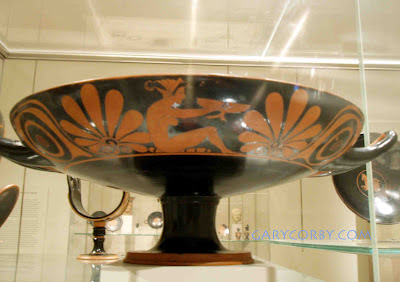
Wine at a party was served in a very wide, very flat cup called a kylix.  Here's one at the Metropolitan in New York:


Yes, the decoration on the outside is a naked woman drinking from a kylix.  Some of the decorations on these things would be rated XXX.  Speaking of which, here's a decoration on the inside of a cup.  This is what you'd see after you've drunk the wine:


The lady is playing a drinking game called kottabos.  That's why she's holding her cup in that funny way.  Here are the rules for kottabos:
  1. Drink your wine to the dregs.
  2. Hold cup as per lady in picture.
  3. Throw the dregs at the nearest wall.

Winners are judged for the most interesting patterns on the host's walls, or possibly the furniture or the fellow guests if someone's a bad shot.  

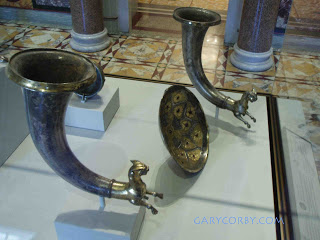
The other, more unusual cup for alcohol, is something much more associated with Vikings, but in fact comes from Persia.  The Greeks called it a rhyton, which is also the English word.  It's a cup in the shape of a horn:


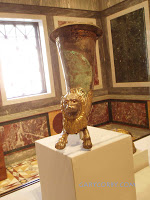
These things were always made in the shape of an animal or some similar subject.  These are at the Getty Villa in L.A., as is this lion:


In The Ionia Sanction at one point I have Nico at a Persian party where he's given a rhyton to drink from in the shape of a boar.


Drink like a Greek: water cups

Ancient Greeks drank water and wine.  Beer wasn't popular.

Water was collected each morning from springs, wells, and, occasionally, public fountains, and carried back to the home. The most famous spring in Athens was called Kallirhoe. It was a tradition to wash in the waters of Kallirhoe on your wedding day.

Most cups were as normal-looking as modern ones, but some were works of art.  The pictures left and right are of a cup in the Metropolitan Museum in New York.  It's the sort of thing you would have found in a wealthy house.

And if you think people took their art seriously back then, check out this cup:


Don't ask me how they got it to stand upright.