A dead man really did fall from the sky

"A dead man fell from the sky, landing at my feet with a thump."  That was the first line in my first book: The Pericles Commission.  

When I wrote that line, I was thinking, what's the most ridiculous way to discover a body that anyone could imagine?  What's something that couldn't possibly happen?

Well, now it's happened.  Residents of Mortlake in London on the 8th September at 7.42am were surprised when a dead man fell from the sky, and landed in one of their residential streets with a resounding thump.

It seems the victim was a stowaway on a jet, who like others before him had decided to hide in the landing gear compartment.  Mortlake is under the flightpath for Heathrow airport.  When the landing wheels descended, out he came.  He was probably already dead.  Very few people can survive unprotected at 30,000 feet.

Here's the story from the BBC news.  They still don't know who he was.


When I began this blog I was stuck for a title, so I used A dead man fell from the sky as a placeholder.  I figured I'd change it later to something that looked more official.

But then when the series sold, and I revamped the web site and changed the name to The Athenian Mysteries, the one piece of clear feedback that came winging back to me was that everyone liked the original name!  So A dead man fell from the sky I am, and shall remain.  But this is a very weird example of life imitating art.
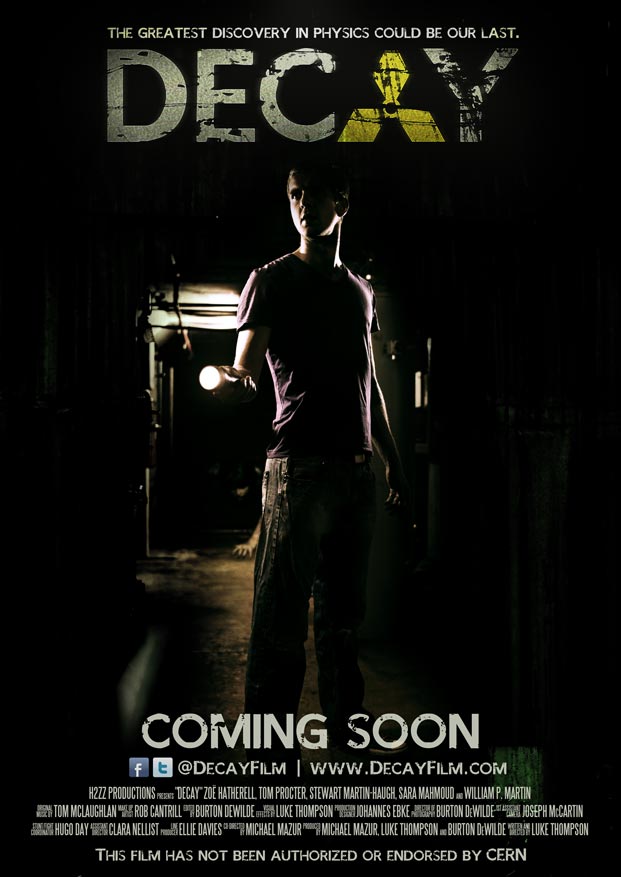

Zombie apocalypse begins at the Large Hadron Collider

You might recall when they discovered the Higgs Particle at the Large Hadron Collider, that I wrote about what is a Higgs particle and why does anyone care.

Now a group of PhD students who work there have made a zombie movie shot on site.  The premise goes that radiation from the Higgs experiments has turned a maintenance crew into zombies who now shamble through the maintenance corridors in search of brains, a food source which should, in theory, be quite plentiful at the LHC.

The movie is acted with all the skill that you would expect a bunch of nuclear physicists to bring to the thespian arts.  But they did a pretty good job on the production.

The movie's 75 minutes.  Here's the trailer:


The last words of Nero

"A pity that such an artist should die." 
 -- Nero, crazed Emperor of Rome and well-known muso.  He really knew how to set a gig on fire.
The story that Nero fiddled while Rome burned is probably false, but he really was a wannabee rock star.  There's a story that once, during yet another purge of the Senate, a number of Senators were rounded up in the middle of the night by the praetorian guard.  The fearful Senators were herded to a theatre, where they were made to sit for a long time, expecting that at any moment they would be slaughtered.  Then suddenly Nero appeared on the stage.  He danced around for a while before disappearing off-stage; then the Senators were allowed to go home.

In the annals of career placement, Nero was an epic fail.   He's Roman, but I can't help mentioning him because of his lovely final words, which have a small chance of being accurate.

Illegal combination of beef with black bean sauce

I told my daughters this story from my past, and they insisted I write it here...

A long time ago I used to work for a small company called Softway, that got operating systems to work on newly invented computers.  Mostly we ported Unix to new hardware, since Unix was the most popular operating system.  The ubiquitous Linux of modern times is based on Unix, so if you think Linux you've got the right idea.

At one time we had a contract to get Unix running on a new line of minicomputers designed and built by a US company called Edge Computing.  They've long since gone out of business, but at the time Edge had sold a lot of machines to a US government department called NASA.  We just had to get Unix running on these boxes.

Now system programmers tend to work hours normally associated with vampires, and there weren't many restaurants open to feed us late at night.  We often ended up at a local Chinese place.  One night one of us ordered the beef with black bean sauce.  I can't recall, but I think it might have been me.

One of our number fancied himself a culinary expert.  He complained loudly that beef with black bean sauce is not a valid Chinese dish.  Which is true.  Every Chinese restaurant in the world serves beef with black bean sauce, but you'll never find it offered in China where it's supposed to come from.

Later that night, said culinary expert called us all over to his workstation.  Unix is written in the C programming language.  A very common error message that you get in C is this:

Illegal combination of pointer and integer types

You don't care what it means, but he had changed it on the new computer so that, after 17 instances of the real message, the computer would instead print this:

Illegal combination of beef with black bean sauce

When printed in system font they were the same length.  We all thought this was hilarious, as such things always are at one in the morning, and went back to our work.  We duly finished the job, shipped a working operating system to Edge, who in turn shipped loads of computers to NASA.

About 6 months later, we get a phone call from NASA.  They're getting a funny error message that says, "Illegal combination of beef with black bean sauce."  They want to know what it means.

We explain that beef with black bean sauce is not a valid Chinese dish.

We sheepishly admit that it's a joke we forgot to remove, that slipped through our final tests.

We are not popular, because it also slipped past the acceptance tests of Edge Computing, who signed it off and whose QA people now look like idiots.  NASA is not amused.  The wrong error message is clearly no danger to anyone, but among other things they're using these systems to design bits that fly in the space shuttle.  If this got through, then what other problems could be lurking in there?

So we had to test the thing all over again!  And luckily for us, though we did pick up some minor problems, there was nothing serious.  This incident inspired me in later years, when I was running projects, to deliberately insert errors into systems to determine how well the testers had done their job.  By measuring how many deliberate errors were found, you could get a statistical measure for how many real errors remained.


Blog tours and book review policy

This isn't a blog post so much as a public service announcement, so if you're a regular reader, you can safely move on to the next one.

I've been getting a lot of requests recently to either host blog tours for people I don't know, or else write reviews for books.  To save people who are considering this the trouble of emailing, here is my policy on this stuff:

I don't host blog tours.  In fact I don't do blog tours myself either.  I do from time to time write guest posts, and I enjoy doing it.  I'd love to do more, the only difficulty being that I have a few deadlines to keep.

I don't do book reviews.

While I do frequently mention books that I've read, it helps if you've been dead for 2,000 years or more.  Slightly less deceased authors who get mentioned tend to be either long-time readers whose success I love to celebrate, writer friends whom I know from fan conferences, writer friends whom I know from across the internet, or books whose awesomeness is so directly relevant to what I typically write about that it's a no-brainer to talk about them.

The blog began as my place for book research overflow .  It's expanded slightly since then, but that remains its primary purpose.  I know my own books are plastered all over the page, but that's because this is also my place of business, sort of.  I used to run two separate web sites: one my author site for the books, and one my blog, then realized that made no sense and merged the two.

I suspect the single most useful piece of author information on this site is my email address down the right hand side.  Any number of fans have used it to email me, and I love to hear from readers, so don't be shy!

For what it's worth to people interested in book marketing, I'd say overwhelmingly the two most effective things are word-of mouth recommendation from people who've enjoyed your books; and the public libraries.  Libraries are grossly underrated.  It's amazing how much of my fan email is from people who discovered me at their local library.