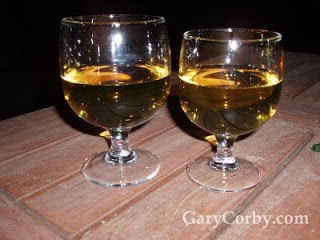
Roman Wine Review: Mulsum

The second wine in our series of genuine (sort of) Roman wine from Tourelles is Mulsum, a red.
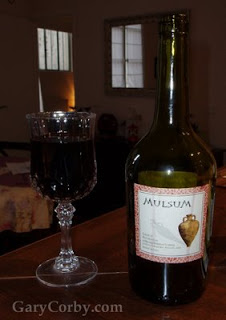

Mulsum tastes like a really nice cough mixture. You know the type I mean: you take a swig to stop your cough so you can sleep at night, and then you take a bit more because it tastes okay.

I'm not using good winey language, I know; I should have said something like, "This wine has a strong, perhaps almost pungent, aftertaste, reminiscent of nuts and pepper," but what I'd really be saying is this tastes like a nice cough mixture. (I can feel any offers of a regular column in Wine Monthly slipping away with every word I write.)

Mulsum is a "normal" red wine to which has been added honey, cinnamon, pepper, thyme, and other spices in lesser amount. I'm guessing the honey and cinammon gives Mulsum the initial smooth taste, almost like a modern wine, and the pepper and thyme deliver the cough mixture finish.

You could probably serve Mulsum at a dinner party in an anonymous bottle and many people wouldn't notice, or at least, not comment. The finish might raise a few eyebrows, and I can imagine someone saying, "This is interesting, what is it?" At that point you could reveal your wine's fascinating provenance from Provence (how's that for alliteration?).

Mulsum was used in Roman times as their equivalent of an aperitif. It would do fine for the same purpose today. The winery suggests drinking it with duck with figs, small quails (of course you cook quail at home, don't you?), spicy dishes or Roquefort.


If Roman wine interests you, then check out the blog for Carenum and Turriculae.
The Bill Gates Connection

Yesterday we visited the Eiffel tower. This involves standing in queues for well over an hour. While standing there a man behind us said to my wife, "Your husband looks just like Bill Gates." He was from Peru and wasn't a techie.

I find this amusing because in the bio on my web site I mention I look somewhat like Bill Gates. I've had numerous experiences where people have confused me for Bill. Yet I can't help feeling no one believes me when I say this. So I'm logging this incident as proof that the most unlikely people, when seeing me in real life, might wonder if I'm Bill Gates. Unfortunately Bill's bank manager has never suffered this confusion.

Roman Wine Review: Turriculae

There is a winery called Tourelles, in Provence in Southern France, which makes wine in the old Roman fashion, with a wine press that duplicates Roman design, using the methods described by Roman writers, and adding the same ingredients as the Romans put into their own wines. It's probably as close as anyone can come today to making a wine that a woman or man of 2,000 years ago might sip and find familiar. This is all just very cool.

I visited them recently and tasted and bought bottles of their three Roman vintages. I've never been a wine critic, and I'm probably beginning with a challenge, but here for better or worse are Gary's Roman wine reviews, which I'll post in tasting order.

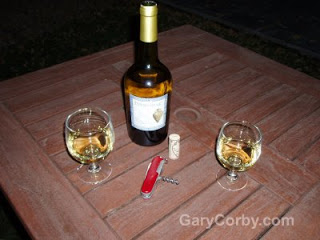
First off is Turriculae, a white wine with some interesting ingredients.


Turriculae is like no modern wine. The first taste is a surprise, courtesy of the fenugreek. Yep, that's right. Fenugreek. You probably know it as something you put in your curry, but the Romans added fenugreek to their wine. In fact the word fenugreek comes from Latin: foenum graecum means "Greek hay".

As the flavor of the fenugreek dissipates there is a salty aftertaste. That's because Turriculae is 2% saltwater. Saltwater, like, from the sea.

Ahh, they don't make wines like they used to.


This may sound yukky, but after a while, it grows on you. The second night my wife and I drank Turriculae, it tasted nicer than the first, and keep in mind that for hundreds of years wealthy, sane people within the Roman Empire bought this stuff and enjoyed it, so there must be something to it. It's all a matter of fashion and what you're used to.

Romans added seawater as a preservative (the salt), as well as for taste. It's known that the Greeks too sometimes cut their wine with seawater, and they too added spices, so my guess is Turriculae is as close as we can come to duplicating the taste of a Greek wine. (As far as I know, no one is making Classical Greek wines the way this winery is making Roman ones.)

There is no way you could pass off Turriculae as a modern wine. If you served it to friends at a dinner party in an anonymous bottle, the first person to take a swig would clutch their throat and choke; not because there's anything wrong with the wine, but because the taste is so very unexpected.

You might try to pass it off as a liqueur from an exotic locale: "I picked up a few bottles of this while passing through Gallia Narbonensis. Do have a splash, it's quite different."

If you get away with it you then can have fun when you reveal to your friends what they've drunk and what's in it, plus you get to show how erudite you are with the joke about Gallia Narbonensis. (It's the name of the Roman province that included Provence).

As you can probably tell, although it was way cool to be drinking Turriculae, I would not walk through ten foot snow drifts to drink any more. But that's only me, and since I dislike all liqueurs and spirits, and Turriculae reminds me a little bit of a liqueur in taste, someone who likes that kind of thing should try it. In fact, everyone should try it at least once if only so you can say you have.


If Roman wine interests you, then check out the blog for Mulsum and Carenum.

Polisher Of Stone

Edward, one of my readers, has asked a question. Wow, my blog is going up in the world! I'm terribly grateful. The paraphrased question is:

Gary Corby, first off love your website ;). (You can see at once Edward is a man of fine taste - Gary). A polisher of stone, or a stone mason/sculptor, I was wondering do you have more information. "Polisher of stone" was it a name given to many or only the select few?
Edward's referring here to the description on my web site of the father of Socrates being a "polisher of stone," and by extension Socrates too.

"Polisher of stone" in Greek meant not so much a stone mason as a sculptor in stone, and marble in particular.

Though it is common belief, it is only by tradition that Sophroniscus, the father of Socrates, was a "polisher of stone." (The Classical Greek term is lithoxoos).

The first documented mention I know of the idea is more than a hundred years after Socrates' death. There is no real evidence contemporary with Socrates himself; neither Plato nor Xenophon mention the profession of either Sophroniscus or Socrates.

I have Sophroniscus as a sculptor in my novels because it suits me, and if I didn't I would have to explain it away for all those people who take the story as true.

Plato does in one of his books have Socrates claiming Daedalus as his ancestor. The way Plato puts it reads to me like Socrates was passing on a family tradition which he accepted as true.

Daedalus is famous as the mythical genius artisan who worked for King Minos of Crete, who helped Theseus when he came to slay the Minotaur, and who invented wings which his son Icarus used to fly too close to the sun, thus creating the world's first airflight disaster. Daedalus is said to have returned to Athens with Theseus, and Socrates claiming him as an ancestor is fair evidence that Socrates comes from the artisan class.

This in itself is odd because it seems certain Sophroniscus had friends in common with Pericles and his father Xanthippus, which you would not expect if the family were artisans. Artisans were middle class; anyone hanging out with Pericles' family would be seriously upper class.

"Polisher of stone" was not necessarily a compliment! At the time of my detective hero Nicolaos, and his irritating younger brother Socrates, the latest fashion in sculpting was not marble, but bronze. People these days think of marble when they imagine Greek sculpture, but that's because some marble work has survived and almost all the bronzework was destroyed long ago. Anyone still working in marble around 460 B.C. was either a traditionalist (which is how I've portrayed Sophroniscus) or else didn't have the greater technical skill required to work in trendy bronze.

So in summary, "polisher of stone" was the Greek term for a marble sculptor, and tradition says Socrates' family was in that business, though no one really knows.

Siege Engines

Okay, I'm a guy. Even though nothing could convince me to fight a war anywhere, any time, I'm still fascinated by military stuff. I might even claim some small competence in military history.

So when in our travels we came across some operational siege engines, it was real cool.

This is a trebuchet in resting position:

Trebuchet

The vertical beam is the catapault arm. There's a weight, barely visible, at the bottom. The two wheels to the right are used to raise the weight and lower the arm, preparing the trebuchet to shoot.

Trebuchet

This is me, in dark top and blue jeans, plus five other guys turning the wheels. You see the weight is going up and the arm down. It's easy to turn at first, but becomes harder as the weight goes up.

The white ball at my feet is a plastic shot.

Now here is the trebuchet being fired. Keep in mind the size and weight when you see it flinging about. A shot could easily fly over a kilometer. As you might imagine, accuracy is not a strong point, but if your target is an entire city then it's kind of hard to miss.


Here's a ballista, a combination massive crossbow and catapault:

Ballista

Ballista

The crossbow part is the high, horizontal beam and ropes coming from it. The "bowstring" loops around the catapault arm, which you see resting at a vertical angle. You wind back the arm, then let go. The catapault is pulled forward, hits the "bow", and whatever's in the cup of the catapault goes flying.

Here's the ballista as seen from the receiving end. Imagine waking up to find a hundred of these parked outside your castle, all pointing in the general direction of you. That probably means it's going to be a bad day at the office. If men are assembling trebuchets being the ballistas, it's probably going to be a very bad day.

Ballista Long Distance


This is a battering ram. The roofing is to protect your people from arrows, boiling oil, etc, thus improving your army's occupational health and safety rating. The heavy beam under the roof is hung to swing backwards and forwards, making it easy to knock on the door.

Battering Ram

These siege engines look exactly like the ones in Age Of Empires. Who says video games disconnect people from reality?