Damonides of Oe: the inventor of the pork barrel

As I write, Australia is in the clutches of a national election, so I thought this would be a good time to write about pork barreling.

The pork barrel appears to have been first used by none other than Pericles.

Pericles' greatest political rival was a man called Cimon. Cimon was an enormously wealthy arch-conservative who was convinced this democracy thing was a big mistake, and that governance of the city should be left in the hands of the better aristocrats. That wouldn't have been a challenge to Pericles, except that Cimon was extremely generous to his fellow citizens, funded major public works from his own pocket, and was even responsible for building the Academy, which later became the school of Plato. To top it off, Cimon's dad was Miltiades, the man who led the Athenians at the battle of Marathon, and Cimon himself was a war hero. Cimon was very, very popular with the people.

Pericles desperately had to do something to counter Cimon, as a me-too gesture.

This from The Athenian Constitution, by Aristotle, from the excellent Penguin edition:
Pericles was the first man to provide payment for jury service, as a political measure to counter the generosity of Cimon. Cimon was as rich as a tyrant: he performed the public liturgies lavishly; and he maintained many of his fellow-demesmen, for any man of Laciadae who wished could go to him each day and obtain his basic needs, and all his land was unfenced, so that anyone who wished could enjoy the fruit.

Pericles' property was insufficient for this kind of service. He was therefore advised by Damonides of Oe (who seems to have been the originator of most of Pericles' measures, and for that reason was subsequently ostracized) that since he was less well supplied with private property he should give the people their own property; and so he devised payment for jurors.
It looks like Damonides of Oe gets the gong for the world's first known spin doctor.

Like most intellectuals of the day, Aristotle was no egalitarian democrat. He then had this to say:
Some people allege that it was as a result of this that the courts deteriorated, since it was always the ordinary people rather than the better sort who were eager to be picked for jury service.
My first ever review!

Here is a milestone moment. The first ever review of my first book, The Pericles Commission. This appears in the August edition of the Library Journal.

Nicolaos is minding his own business in ancient Athens when a body falls from the Areopagus above. Pericles, a rising politician, arrives moments later, and together they identify the corpse as that of Ephialtes, leader of the democratic movement and Pericles's friend. After a brief conversation, Pericles determines that Nicolaos is a man of keen insight and commissions him to investigate the highly volatile murder. Corby uses the early chapters to explain for the modern reader everything from Athenian politics and the place of women to monetary matters and clothing. Once the story gets rolling, though, it moves along at a good clip, even borrowing some tropes from the noir subgenre-a beating for the hero, a femme fatale, and plenty of shifty characters. As he explains in his author's note, Corby draws the murder and many of his characters from historical documents, lending that much more believability to the story.

VERDICT This series opener will appeal to historical mystery fans and readers who enjoy Lindsey Davis and Kelli Stanley.

-Eric Norton, McMillan Memorial Lib., Wisconsin Rapids


The oldest bridge in the world

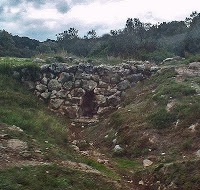
Here's your trivia for the day. As far as I'm aware, the world's oldest still-in-use bridge was built in Mycenaean times! Here's a picture from wikimedia:


The bridge lies on a bronze age highway between the cities of Tiryns and Epidauros. The ruins of both cities still exist, by the way, and are well worth a look.

This is a drystone construction with a tiny arch in the middle. The downward pressure of gravity combined with the solid placement of the rocks holds everything in place. Those rocks have sat there for about 3,300 years. Yes, this thing was built in about 1300BC.

When people first walked across this bridge, Minoan civilization was on its last legs. It was the post-palatial period, when Knossos declined and Mycenae rose. Local villagers use it to this day.


Another Word Tip, from Jane Finnis

You might recall that I previously mentioned Jane Finnis, who writes ancient mysteries set in Roman Britain.

Jane left me this very useful tip on writing with Microsoft Word:
Not everyone knows that when doing a straight "Find" in Word, once you've typed in your keyword, you can press Escape and move between occurrences of the word by hitting Control with PageDown or PageUp. Often quicker than the button.
Jane is remarkable for writing mysteries starring innkeeper Aurelia Marcella, thus making her one of the very few mystery writers with a female detective in the ancient world. I only discovered yesterday that she also writes this very interesting blog.